Key takeaways
- Together AI released Hurdle, an open-source npm library for agent evals, on November 25, 2026.
- It runs Claude Code or Codex on tasks against your product and scores each run with code checks, guards and an LLM judge.
- Sandboxed runs need Together credits, and it requires Node.js 22.18 or later plus an Anthropic or OpenAI key.
Together AI released Hurdle on November 25, an open-source npm library that runs Claude Code or Codex against tasks on your own product and reports how often the agent gets them right. The company announced it in a blog post and published the code on GitHub.
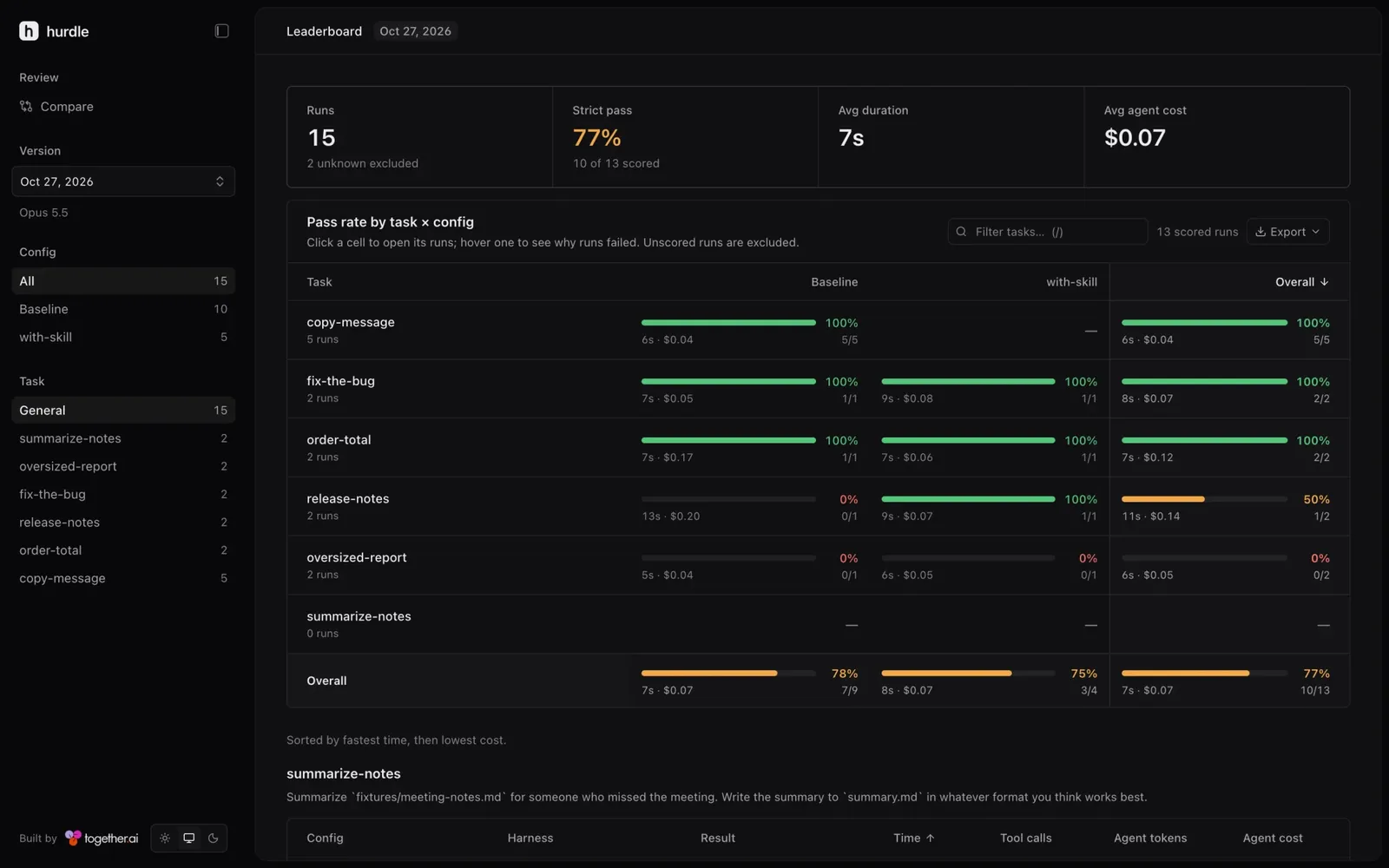
It is built for teams that want to know how well coding agents handle their API, skills and docs. If an agent keeps calling an API wrong, a suite can show that, and show whether a skill or an MCP server helps. The examples in the post compare a "baseline" run with a "with-skill" run of the same task.
How Hurdle scores a run
Each run is graded three ways. Code checks confirm that required API requests happened and expected files exist. Guards block actions you don't allow and count any attempt as a failure. An LLM judge grades the result against a rubric written in plain English, and a suite can require both the code checks and the judge to pass. A results viewer shows pass rates by task, model and condition, with time and cost per run. The sample in the post shows a 77% strict pass rate over 15 runs at an average agent cost of $0.07.
What it needs
Hurdle needs Node.js 22.18 or later, the Claude Code or Codex CLI, and an Anthropic or OpenAI key or a Claude OAuth token. Runs can happen locally or in Together's sandboxes, which need a TOGETHER_API_KEY and Together credits; the post says the starter example costs "a fraction of a cent" on Together's side. Local runs can't use guards or request checks, and the agent can reach local files and keys.
For background on how teams test models and agents, see our explainer on AI evals. Together also launched preemptible GPU compute at half the on-demand price a day earlier.