Key takeaways
- AI evals are repeatable tests that score a model's or an app's outputs against criteria you set, so versions can be compared.
- Anthropic's docs rank graders by speed and reliability: code checks first, LLM judges for judgment calls once tested, human grading last.
- An LLM judge should be checked against expert pass/fail labels using its true positive and true negative rates before it replaces human review.
AI evals are repeatable tests that check whether a language model, or an app built on one, does what you need. Each eval is a set of inputs, a way to grade every output, and a score you can compare from one version to the next. OpenAI's evals guide defines them as tests of model outputs "to ensure they meet style and content criteria that you specify."
Labs use evals to measure what models can do in general. Product teams use them to check that their app still works after each change.
Benchmarks vs task evals
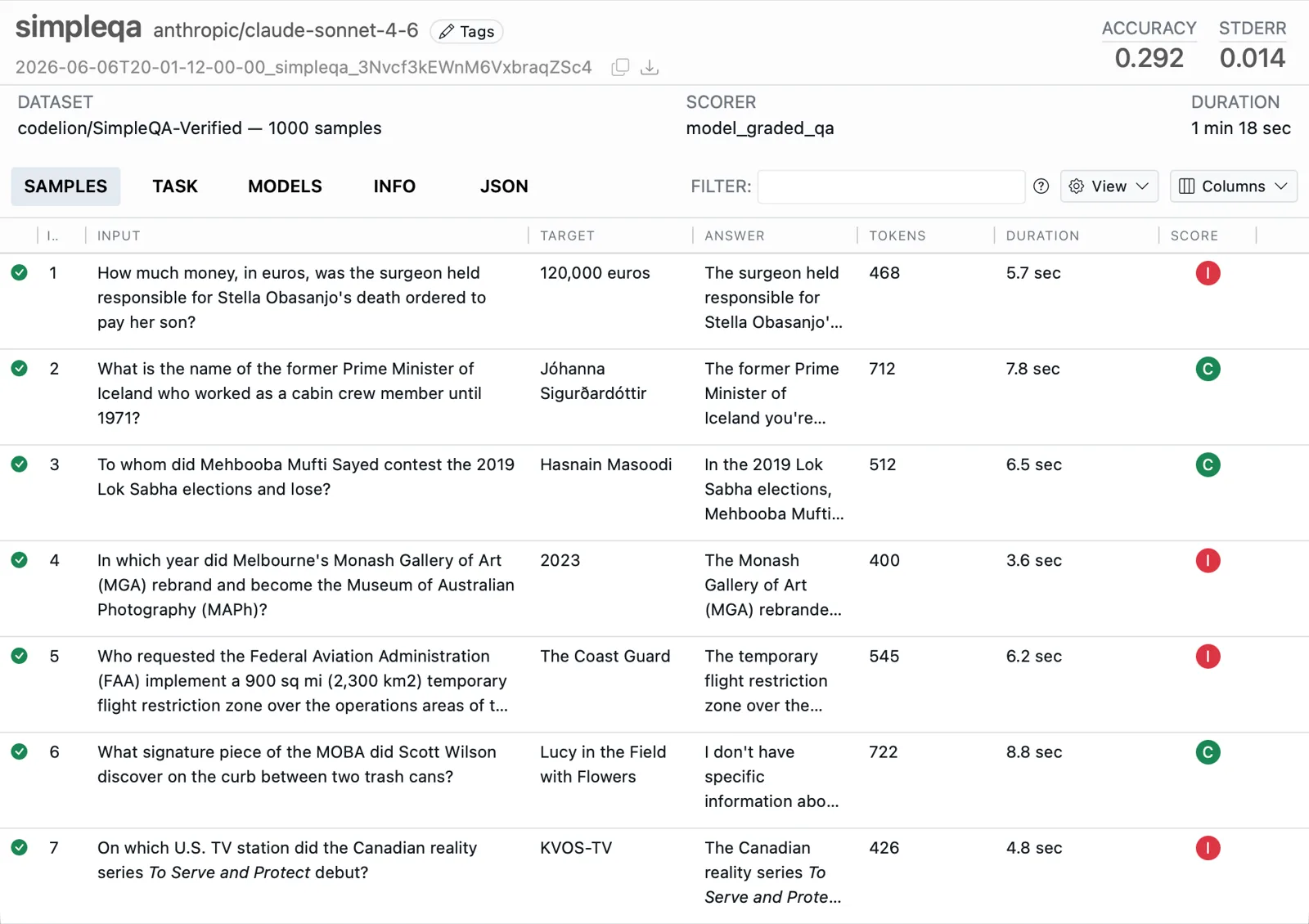
A benchmark is a public, fixed test every model can take: GPQA Diamond for graduate-level science, FrontierMath for hard math, SWE-bench Verified for fixing real GitHub issues. Epoch AI's Benchmarking Hub tracks results on about 100 of them.
A task eval is private and built from one product's own data, such as real support tickets with the right category for each.
A model that tops a benchmark can still fail your task. Epoch itself warns that scores can be skewed by contamination (test questions leaking into training data) and by small prompt changes. Use benchmarks to shortlist models and a task eval to decide. See the fine print behind AI coding benchmarks.
How to build an eval for your own app
Anthropic's guide to building evals starts with success criteria that are specific and measurable: "accurate sentiment classification", not "good performance". Its design rules: mirror the real mix of tasks and edge cases, automate grading, and prefer many automatically graded questions over a few graded by hand.
Practitioners Hamel Husain and Shreya Shankar add a step before that. Their AI evals FAQ, updated in September 2026, says to begin with error analysis, not tooling. Read at least 100 real traces (the full record of what the app saw and did), note what went wrong, and group the notes into failure types. Each type then gets its own check.
Code-based checks
Code is the cheapest grader. Anthropic ranks it first: the fastest, most reliable and most scalable method, though too rigid for judgment calls. Typical checks:
- Exact match: the output equals the known answer, as in a classifier.
- String match: a required phrase appears, or a banned one doesn't.
- Structure: the JSON parses, the SQL runs, the generated code passes its tests.
- Similarity to a reference text, such as ROUGE-L or embedding cosine similarity.
OpenAI's guide grades an IT ticket classifier with a string_check against human labels. Husain and Shankar's rule is to use code whenever an objective rule can spot the failure. They also warn that generic "helpfulness" or "similarity" scores create false confidence when treated as measures of quality.
LLM-as-judge, and calibrating it against human labels
Some failures no rule can catch, like a rude reply or a summary that drops the key fact. For those, a second model grades the output: LLM-as-judge.
Anthropic calls model grading fast, flexible and good for complex judgment, on one condition: test that it is reliable before you scale it. Its tips are to give the judge a detailed rubric, demand a fixed output such as "correct" or "incorrect", let the judge reason before it scores, and grade with a different model from the one that wrote the answer. Husain and Shankar prefer plain pass or fail to 1-to-5 scales, because binary labels force clearer, more consistent decisions.
Calibration is how you learn whether the judge can be trusted. A domain expert labels outputs by hand as pass or fail; the FAQ suggests 100 to 200 per failure type. Split them into train, dev and test sets, tune the judge's prompt on the first two, then measure it once on the untouched test set:
- True positive rate: of the outputs the expert failed, the share the judge also failed.
- True negative rate: of the outputs the expert passed, the share the judge also passed.
A judge that scores high on both can stand in for the expert at scale. One that misses real failures reports a healthy product that isn't.
Regression gates
The most useful thing to do with an eval suite is run it on every change. OpenAI's guide says to rerun evals whenever prompts or models change, to catch regressions.
A regression gate makes that automatic. The suite runs in continuous integration on each pull request or model upgrade, and the change doesn't ship if a check's pass rate drops below its threshold. The FAQ notes that evals cost much more than unit tests to run and maintain.
Real Python's tutorial LLM evaluation in Python builds such a harness from scratch, release gate included. Inspect, an open-source framework from the UK AI Security Institute and Meridian Labs, packages the parts and ships with more than 200 ready-made evals.
What METR, Epoch AI and the UK AISI do
Companies' own scores are claims. Independent evaluators test the same models from outside.
METR is a nonprofit that measures what AI agents can do and the risks that follow. It says it has partnered with OpenAI, Anthropic, Google DeepMind, Meta and Amazon to pilot frontier risk assessments. Its best-known measure is the time horizon: the length of task, in human expert time, that an agent is predicted to finish half the time. More in the METR time horizon explainer.
Epoch AI runs its own benchmarks on leading models and collects others from official leaderboards. For the ones it runs, it publishes the setup: the Inspect framework, zero-shot chain-of-thought prompts, an empty system prompt, default temperature, and error bars of one standard error.
The UK AI Security Institute tests frontier models, including before release. A 2024 post on its approach lists automated evals graded by models against expert rubrics, agent tasks such as capture-the-flag challenges, expert red teaming, and studies comparing people with and without AI. It adds a warning: "strong claims should not be drawn directly from automated testing in isolation."
This week: METR asks for a better yardstick
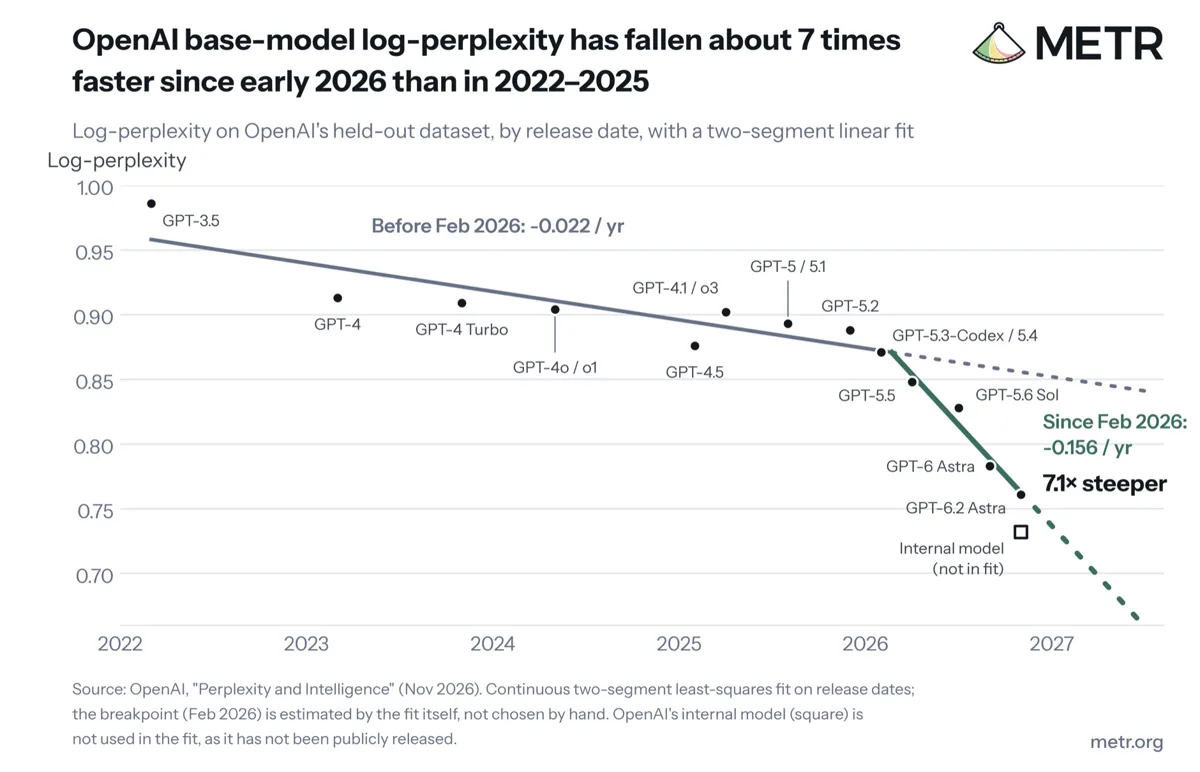
On November 24, 2026, METR published an analysis of OpenAI's pretraining loss. OpenAI had released log-perplexity for 13 base models trained since GPT-3.5, all measured on one held-out set from its own codebase. Lower log-perplexity means a model is less surprised by unseen text (explainer). METR found it falling about 7 times faster since early 2026 than in 2022 to 2025, as covered here.
The eval lesson is in what METR asked for next. One test set from one company can't rule out overfitting, so METR asked developers to report loss on other held-out text, possibly kept by a third party. A score means little until you know what it was measured on and whether someone else can reproduce it.
Where to start
Read 100 real outputs and note what went wrong. Write code checks where a rule works, a calibrated judge where it doesn't, and run both on every change. Evals only catch failures someone thought to test for, so keep reading traces for new ones, such as hallucinations.
A note for OpenAI users: the company is deprecating its hosted Evals platform. Its docs say it became read-only for existing users on October 31, 2026, and is scheduled to shut down on November 30, 2026, with Datasets suggested instead.
Frequently asked questions
What are AI evals in simple terms?
They are tests for AI output: a set of inputs, a way to grade each answer, and a score. OpenAI's docs describe evals as tests that check model outputs meet the style and content criteria you specify.
What are AI evals for engineers and product managers?
For people building AI products, evals are a private test suite drawn from the app's own data. Hamel Husain and Shreya Shankar recommend starting by reading at least 100 real traces, grouping the failures, and writing a code check or a calibrated LLM judge for each failure type.
What is an example of an AI eval?
OpenAI's evals guide uses an IT support ticket classifier: a dataset of tickets with human-labeled categories, and a string check that compares the model's label with the correct one. The pass rate is the score, rerun after every prompt or model change.
Are there open-source AI eval tools?
Yes. Inspect, built by the UK AI Security Institute and Meridian Labs, is an open-source framework for LLM evaluations with more than 200 ready-made evals, and Epoch AI uses it to run its own benchmarks.
Sources
- Working with evalsOpenAI
- Define success criteria and build evaluationsAnthropic
- AI Evals: Everything You Need to KnowHamel Husain and Shreya Shankar
- Interpreting a recent acceleration in pretraining lossMETR
- About METRMETR
- Time horizonsMETR
- AI Benchmarking HubEpoch AI
- InspectUK AI Security Institute
- Early lessons from evaluating frontier AI systemsUK AI Security Institute
- LLM Evaluation in Python: Build an Eval Harness From ScratchReal Python