Key takeaways
- The Claude app is for chat and, through Cowork, non-coding tasks; Claude Code is an agent that edits, tests and commits code in a project.
- As of November 16, 2026, every paid plan includes both, from Pro at $20 a month, and the Free plan does not include Claude Code.
- Claude and Claude Code share one usage limit, so time spent in one leaves less for the other.
The short answer to Claude Code vs Claude: Claude is Anthropic's assistant app: you chat with it on the web, in the desktop app or on your phone, and with Cowork it can work through files and tasks for you. Claude Code is Anthropic's coding agent: it reads your codebase, edits files, runs commands and opens pull requests, in your terminal, your IDE, the desktop app or the browser. As of November 16, 2026, every paid Claude plan includes both, starting with Pro at $20 a month, and the pricing page says the two draw from one shared usage limit.
So the comparison is less a choice between two purchases than a choice between two tools you already pay for. The question is which one fits the job in front of you.
This comparison is based on Anthropic's pricing page, product pages, help center and Claude Code docs, read on November 16, 2026. It is not a hands-on test.
What the Claude app does
The Claude app is the chat product at claude.ai, plus the desktop app for macOS and Windows and the iOS and Android apps. You type a question or paste a document, and Claude answers. According to the pricing page, even the Free plan can search the web, create files, run code, keep memory across conversations, connect apps and tools, and build Artifacts (small documents, apps or diagrams that appear next to the chat). Paid plans add Projects without the five-project cap, Research, Opus models, Claude in Chrome and Claude for Microsoft 365.
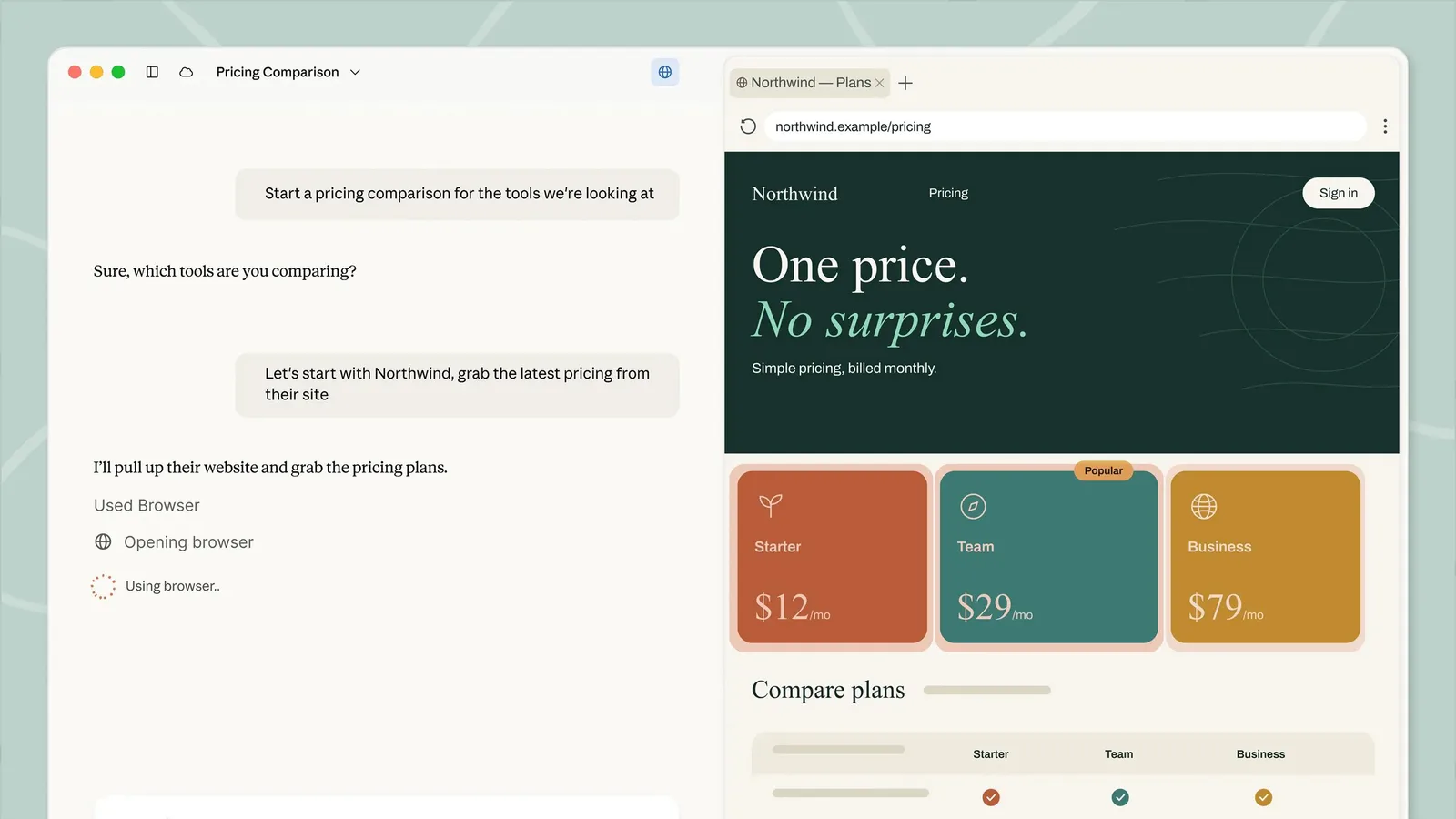
Cowork is the part of the app that does work instead of describing it. Anthropic's Cowork page calls it an agent mode for non-coding work: you set a goal, and Claude reads, edits and creates the files you select, across your tools. Research, analysis and documents are the examples Anthropic gives. Cowork runs on desktop, and is rolling out on web and mobile. Only the desktop app reaches the folders and applications on your own computer. Anthropic says Cowork is now part of Claude: every conversation starts as a chat, and Claude uses Cowork when a task needs it.
What Claude Code does
Claude Code is built for software work. You start it inside a project, describe what you want in plain language, and it plans the change, edits files across the codebase, runs your tests and commands, and works with git: staging, commit messages, branches and pull requests. You approve what it may do. Anthropic's product page says it can take on "a bug fix, test, or multi-day migration."
It is also something you can program. The docs list:
CLAUDE.mdfiles with project instructions it reads at the start of every session.- Skills, which package repeatable workflows, and hooks, which run shell commands before or after its actions.
- MCP servers, which connect it to tools such as Jira, Slack or Google Drive.
- Subagents and background agents that work on parts of a task in parallel.
- A scriptable CLI (
claude -p) for pipes and CI, plus GitHub Actions, GitLab CI/CD and Slack. - Scheduled tasks that run in the cloud or on your machine.
Where each one runs
The names overlap, which is where most of the confusion comes from. Claude Code runs in five places:
- Terminal: the full CLI, installed with one command on macOS, Linux, WSL or Windows.
- IDE: an extension for VS Code and Cursor, and a plugin for JetBrains IDEs.
- Desktop app: the same Claude desktop app you chat in. Sign in and click the Code tab. The docs say the app includes Claude Code, so you don't need to install the CLI, and that it needs a paid subscription.
- Web: claude.ai/code runs sessions in the cloud with no local setup, on desktop browsers and in the Claude iOS and Android apps.
- Slack and CI: mention
@Claudein Slack, or run it in GitHub Actions or GitLab.
So "Claude Code vs Claude desktop" is not two apps. The desktop app holds both: chat and Cowork in one place, Claude Code under the Code tab. For more on that tab, see the Claude Code desktop app.
Claude Code vs Claude at a glance
As of November 16, 2026, from Anthropic's pricing page, product pages and docs:
| Claude app (chat and Cowork) | Claude Code | |
|---|---|---|
| Built for | Questions, writing, research, analysis, documents | Writing, fixing and shipping software |
| How you use it | Chat in a window; Cowork works on files you select | Runs inside a code project and acts on it |
| Where | claude.ai, desktop app (macOS, Windows), iOS, Android | Terminal, VS Code, Cursor, JetBrains, desktop Code tab, claude.ai/code, Slack, CI |
| Acts on your computer | Cowork, in the desktop app, on folders you pick | Reads and edits the whole project, runs shell commands and git |
| Free plan | Yes, with limited usage | No |
| Cheapest paid plan | Pro, $20 a month ($17 a month billed annually) | Pro, $20 a month ($17 a month billed annually) |
| Usage limits | Shared pool | Same shared pool |
| Pay per token instead | Not offered | Yes, with a Claude Console account at API rates |
| Customization | Projects, Skills, connectors, memory | CLAUDE.md, Skills, hooks, MCP, subagents, scripting |
Which plans include each, and what they cost
Prices as of November 16, 2026, from claude.com/pricing, before tax:
| Plan | Price | Claude app | Claude Code | Usage |
|---|---|---|---|---|
| Free | $0 | Yes | No | Limited |
| Pro | $20 a month, or $200 a year ($17 a month) | Yes | Yes | 1x |
| Max | $100 a month, monthly only | Yes | Yes | 5x Pro, every 5 hours and every week |
| Ultra | $200 a month, monthly only | Yes | Yes | 10x Pro every week, no 5-hour limit for verified accounts |
| Team, standard seat | $25 a seat a month, or $20 billed annually | Yes | Yes | More than Pro |
| Team, premium seat | $125 a seat a month, or $100 billed annually | Yes | Yes | 5x a standard seat |
| Enterprise | $20 a seat a month billed annually, 20-seat minimum, plus usage at API rates | Yes | Yes | Spend limits set by admins |
Max includes $100 a month in API credits and Ultra $200, for building on the Claude Platform. Team plans pool up to $500 a month in API credits. The Team plan lists "Claude Code and Claude Cowork" together. The Cowork page says it is rolling out to Pro, Max and Ultra and works with a paid plan.
The one real price difference: Claude Code can skip the subscription. The product page says that with a Claude Console account, Claude Code "consumes API tokens at standard API pricing." The chat app has no such option. Whether that costs more or less than a plan depends entirely on how much you use it; is Claude Code free goes through that question.
Usage limits are shared
This is the detail that catches people. Anthropic's help article on using Claude Code with a Pro, Max or Ultra plan says the limits "are shared across Claude and Claude Code, meaning all activity in both tools counts against the same limits." The pricing page says the same: activity on web, desktop, mobile and Claude Code all draws from one pool, with a rolling five-hour window and weekly limits on paid plans.
In practice, a long Claude Code session in the afternoon leaves less for chat in the evening, and the other way round. Cowork, which the app's agent mode uses, "consumes limits faster than Chat," according to its product page. How fast you reach a limit also depends on the model, the length of the chat and the size of the files.
When you hit the limit, the pricing page lists three ways out: wait for the reset, move to a bigger plan, or turn on usage credits on a paid plan and keep working at standard API rates. You can check where you stand in Settings > Usage.
One trap from the help article: if an Anthropic API key is set in your environment, Claude Code uses that key instead of your subscription, and you pay API rates for that work.
When to use Claude, and when to use Claude Code
Use the Claude app when the output is an answer or a document: explaining a concept, drafting an email, summarizing a PDF, researching a market, building a quick chart. Use Cowork when you want the work done across files that aren't code, such as turning a folder of notes into a report.
Use Claude Code when the output is a change to a codebase. The chat app can write a function you paste into your editor. Claude Code can find where that function belongs, write it, run the tests, fix what fails and open the pull request. The bigger the project, the wider that gap.
For a developer on Pro or above, the honest answer is both: chat for thinking out loud, Claude Code for the work in the repository. They cost nothing extra to combine, but they spend the same allowance, so heavy coders feel the limits sooner than people who only chat.
If you are comparing Claude Code with other coding agents rather than with the Claude app, see Claude Code vs OpenCode. For Cowork against Microsoft's agent, see Copilot vs Cowork.
Frequently asked questions
Is Claude Code free?
No. As of November 16, 2026, Claude Code comes with the Pro plan ($20 a month) and higher, and the Free plan does not include it. You can also skip the subscription and pay per token at standard API rates with a Claude Console account.
Is Claude Code different from Claude?
Yes. Claude is the chat app on the web, desktop and phone. Claude Code is a coding agent that works inside a project, editing files, running commands and handling git, though the desktop app holds both, with Claude Code under the Code tab.
Do Claude and Claude Code share usage limits?
Yes. Anthropic's help center says the limits are shared across Claude and Claude Code, so all activity in both counts against the same five-hour and weekly limits.
What is the difference between Claude Code and Cowork?
Anthropic positions Claude Code for software engineering and Cowork for non-coding work such as research, analysis and documents. Both are agents that act on files, and Cowork lives inside the Claude app.
Sources
- Plans and pricingAnthropic
- Claude Code overviewAnthropic
- Use Claude Code with your Pro, Max, or Ultra planAnthropic
- Claude CodeAnthropic
- Claude CoworkAnthropic