Key takeaways
- Superhuman Go is an AI assistant from Superhuman, the company named Grammarly until October 2025, and Grammarly now runs inside it as one of its agents.
- Go runs as a Chrome or Edge extension, a desktop app and mobile apps, is free to start, and costs $12 (Pro) or $33 (Business) per member per month billed annually as of November 19, 2026.
- On November 19, 2026, Superhuman turned Go into a personal assistant you name yourself and brought it into Docs and Mail, with most features rolling out from December 2026 into early 2027.
Superhuman Go is an AI assistant from Superhuman, the company that was called Grammarly until October 2025. It runs in a browser extension, a desktop app and on phones, and pops up inside the apps you already use, like the Grammarly underline did, instead of waiting in a separate chat window. On November 19, 2026, Superhuman announced that Go is becoming a personal assistant you name yourself, and that it now reaches into Superhuman Docs and Superhuman Mail.
Go is free to start. Paid plans cost $12 a month per person on Pro and $33 on Business when billed annually, or $15 and $40 month to month, according to Superhuman's Go pricing page as of November 19, 2026.
What Superhuman Go does
Go reads what is on your screen and offers help where you type. Superhuman's product page lists four jobs: writing suggestions, sorting email and drafting replies, meeting prep and follow-up, and building project trackers from your apps.
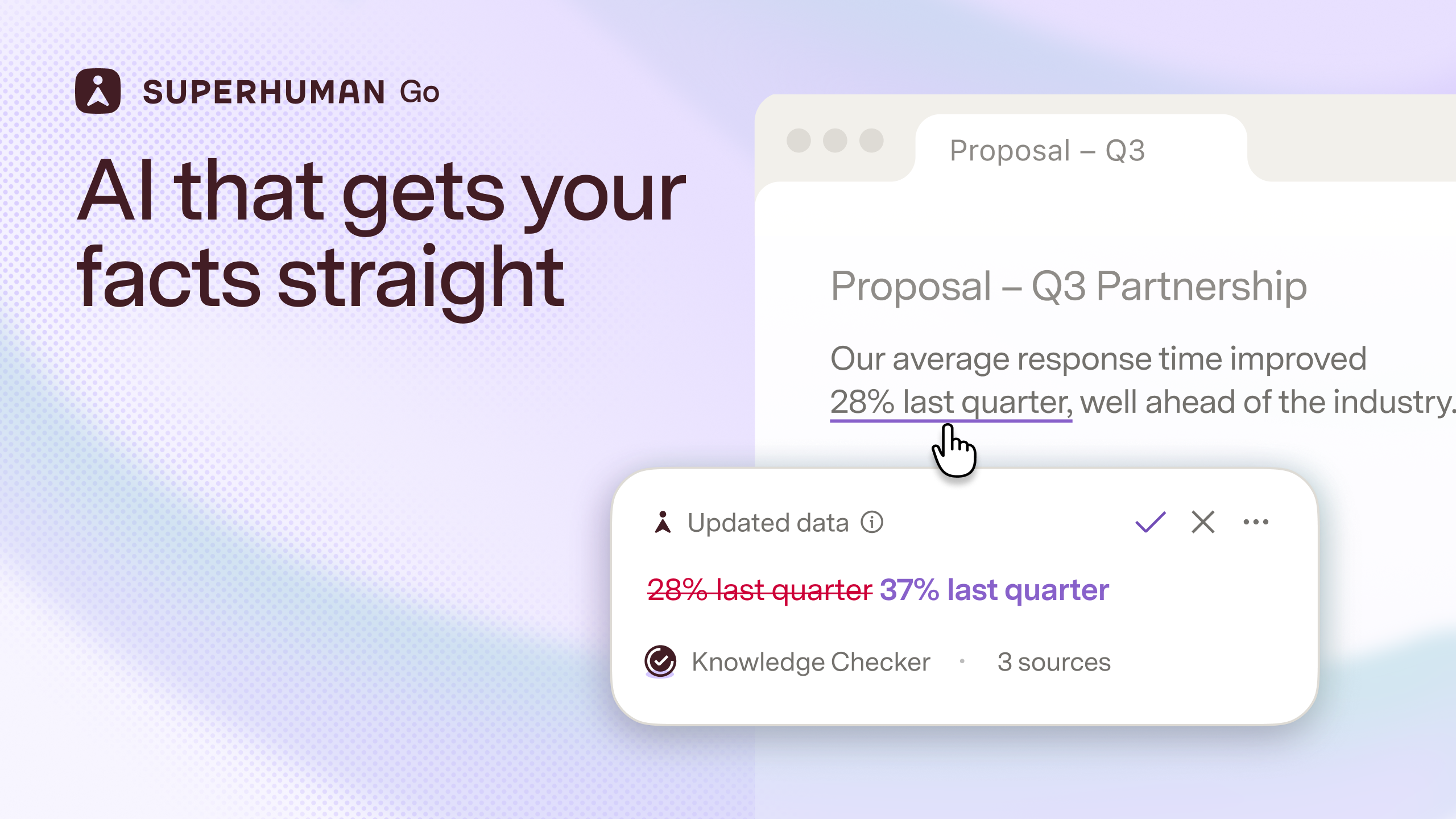
Under the hood, Go is a manager of smaller AI helpers that Superhuman calls agents. Each agent does one job. The default set on the product page includes Grammarly for writing, Email Assistant, Knowledge Checker, which flags numbers in your draft that disagree with your sources, and Daily Brief. An Agent Store adds ready-made agents from Superhuman and partner companies, and paid plans let you build your own without writing code.
Go also connects to work apps such as Gmail, Slack or Jira, so it can draw on your email, calendar and tickets. Which ones depends on your plan.
Is Superhuman Go the same as Grammarly
No. Grammarly is one product, and Go is another that contains it.
Superhuman is the company. Grammarly renamed itself Superhuman on October 29, 2025, when it bundled four products into one suite: Grammarly, the writing assistant; Coda, an all-in-one workspace; Superhuman Mail, an AI email app; and Go, which was new that day. The company said at the time that "the Grammarly product will still exist."
Go is built on Grammarly's writing technology, and Grammarly's suggestions show up as one of Go's agents. The difference is scope. Grammarly fixes the text you write. Go can also chat about the page you are on, pull facts from your connected apps, draft emails and act on tasks. Superhuman's product page says existing Grammarly users can switch to Go in their settings without installing anything new.
Where Superhuman Go runs
Superhuman lists these ways to use Go:
- Browser extension: Superhuman Go for Chrome and for Edge. This is the main way in, and the plans page tells new users to start by installing it.
- Desktop app: for Mac and Windows. The FAQ on the plans page still calls the Windows app "coming soon," while the product page lists it as available, so check before you rely on it.
- Mobile apps: iOS and Android, according to the product page.
- Web: go.superhuman.com.
Superhuman says Go works across more than 1 million apps and websites.
How much Superhuman Go costs
Prices are per member per month, from the Go plans page as of November 19, 2026.
| Plan | Billed annually | Billed monthly | What it adds |
|---|---|---|---|
| Free | $0 | $0 | Basic inline suggestions from Grammarly and other agents, limited chat with your tabs and apps, shareable docs, sync across devices |
| Pro | $12 | $15 | Customizable suggestions, chat and prompts at your cursor, Email Assistant, personal connectors (Superhuman Mail, Gmail, Calendar, Outlook, Slack), a limited number of custom agents. Includes Grammarly and Docs |
| Business | $33 | $40 | Team connectors (Jira, Linear, Asana, Confluence, Zendesk), more custom agents. Includes Grammarly, Docs and Mail |
| Enterprise | Custom | Custom | Enterprise connectors (Salesforce, HubSpot, Workday, ServiceNow), security and admin controls, full custom agents with access control |
A few details in the fine print matter:
- The page gives no hard numbers for limits. Free has "limited" chat, and paid plans get a "limited free trial of full chat" and a "limited trial" of usage credits. Usage tracking is listed as coming soon on every plan.
- The comparison table says Grammarly is "Included with annual plan or add for $15/member when billed monthly." If you want full Grammarly, annual billing is the cheaper route.
- Model training on your data is opt-out on Free, Pro and Business, and off by default on Enterprise.
What changed on November 19, 2026
Superhuman announced it at its first user conference, in San Francisco. TechCrunch and SiliconANGLE both reported it the same day. The changes:
Go becomes a personal assistant
You give Go a name and pick how it looks. During setup it asks you to connect your tools so it can learn how and where you work, then recommends agents. After that it watches your connected apps, flags and ranks tasks, and suggests next steps, like answering an important email or preparing for a meeting. Superhuman says you approve every action. Go also learns your writing voice from your past emails and drafts.
Go moves into Docs and Mail
- Docs: you can @-mention an agent in a doc to hand it work, or set a trigger so it runs on its own, even when the doc is closed. Every agent action is logged in version history.
- Mail: Go replaces the "Ask AI" feature in Superhuman Mail. It triages the inbox, searches your connected tools and can create a ticket or update a CRM from an email. A new Mail Home view shows your three most important items each day. Auto Drafts can now pull context from Slack, meeting notes and internal docs. Superhuman says they save nine minutes per draft on average.
- Fathom: the meeting notetaker Superhuman bought in September 2026 now records without a bot joining the call for most users, writes shared live notes, and passes meeting to-dos to Go.
More partner agents and an open SDK
Superhuman announced more than 20 new partner agents, including ones from Legora, Databricks, Amplitude, Blackboard, DeepL, Gamma, Apollo, Bitly and Saifr. Its Go platform SDK, the kit for building agents that run inside Go, is now generally available to partners and customers.
When you get it
Most of this is not out yet. According to the announcement:
- The new Go assistant rolls out "over the next few months," with early access through the Superhuman Community.
- Partner agents start rolling out on November 19 and over the following weeks.
- Agents in Docs enter open beta on December 1, 2026 for self-serve customers, and in the first quarter of 2027 for enterprise customers.
- The Mail features go into beta in November 2026 and become generally available in early 2027.
- The Fathom changes are available now.
The announcement does not say which plans get the personal assistant, or whether prices will change.
How many people use it
Superhuman says Go passed 1 million monthly active users and is growing about 20% a month, and that more than 40 million people use its products every day. Those are the company's own numbers.
The bet is that people will use AI more if it comes to them than if they have to open a chatbot. CEO Shishir Mehrotra put it as closing "the gap between deployment and adoption." Superhuman's head start is that many of its 40 million daily users already have its extension installed. Whether they want an assistant that watches their inbox, not just one that fixes their commas, is the open question.
Frequently asked questions
Is Superhuman Go the same as Grammarly?
No. Grammarly is a writing assistant, and Go is a broader AI assistant that includes Grammarly as one of its agents. Both come from Superhuman, the company formerly called Grammarly, and Grammarly users can switch to Go in their settings.
Is Superhuman Go free?
Go has a free plan with basic inline suggestions and limited chat. Pro costs $12 per member per month billed annually or $15 monthly, and Business costs $33 or $40, as of November 19, 2026.
Is there a Superhuman Go Chrome extension?
Yes. Superhuman Go for Chrome and Superhuman Go for Edge are the main way to use it, and Superhuman also offers a desktop app, mobile apps and a web version at go.superhuman.com.
When does the new Superhuman Go personal assistant arrive?
Superhuman said on November 19, 2026 that it rolls out over the next few months, with early access through the Superhuman Community. Agents in Docs open in beta on December 1, 2026 for self-serve customers.
Sources
- Superhuman Expands Go Across the Suite, Unveils Personal AI AssistantSuperhuman
- Superhuman Go plans and pricingSuperhuman
- Superhuman GoSuperhuman
- Superhuman plansSuperhuman
- Becoming SuperhumanSuperhuman
- Superhuman pushes its Go assistant everywhereTechCrunch
- Superhuman unveils personal AI assistant and expands Go across entire suiteSiliconANGLE