Key takeaways
- Java4Shell (CVE-2026-114938) is a memory-corruption bug in OpenJDK's AVX-512 Base64 decoder that Calif says leads to remote code execution.
- OpenJDK lists Java 17, 21, 25 and 27 as affected and released fixes on November 17; only x86-64 chips with AVX-512 VBMI are exposed.
- Calif says a researcher found the bug with OpenAI's Codex in about an hour, for under $200 in model usage.
Security firm Calif disclosed Java4Shell on November 17, a memory-corruption bug in OpenJDK that can let an attacker with no login run code on a Java server. The flaw is tracked as CVE-2026-114938, and Calif's write-up says its researcher found it while using OpenAI's Codex to audit the Java virtual machine. OpenJDK and Oracle shipped fixes the same day.
Java runs a large share of the software companies use internally, so a bug that turns a short string of text into remote code execution matters well beyond Java developers. Calif says it got working attacks against default installs of Keycloak, Jira, Confluence, Artifactory, Jenkins and PingFederate without any credentials.
What the bug is
The problem sits in HotSpot, the part of OpenJDK that compiles Java code to machine code while it runs. On x86-64 chips, HotSpot swaps the standard Base64 decoder for a hand-tuned version that uses AVX-512 instructions, a set of wide vector instructions on newer Intel and AMD server chips. Calif says that version miscalculates the length of the padded end of the input. The length goes negative, and the decoder writes 64 bytes into a 50-byte buffer.
The trigger is plain text: 64 A characters followed by =, or 128 on OpenJDK 17. Any server that Base64-decodes data a user sends, which is very common in login and token handling, can be reached. Calif says the bug lets an attacker overwrite memory, read it back in a way it compares to Heartbleed, and get to remote code execution.
It only bites on x86-64 processors with the AVX-512 VBMI extension. Calif lists Intel Xeon from Ice Lake onward and AMD EPYC and Ryzen from Zen 4 onward. ARM servers are not affected.
Which versions are affected
The OpenJDK advisory for November 17 lists the bug as affecting Java 17, 21, 25 and 27, and says the affected builds are 27.0.1.0.3, 25.0.5.0.3, 21.0.13.0.3, 17.0.21.0.3 and earlier. Calif puts the start at OpenJDK 17.0.6. Builds made from OpenJDK carry it too: Calif names Amazon Corretto, Eclipse Temurin, Microsoft's build, Azul Zulu, BellSoft Liberica, SAP SapMachine, Red Hat's OpenJDK and Oracle GraalVM.
The two sides score it differently. OpenJDK and Oracle's November Critical Patch Update rate it 8.1 out of 10 under CVSS 3.1. Calif rates it 9.2 under the newer CVSS 4.0. Oracle's update credits two people for reporting it: Quang Luong of Calif and Albert Yang.
What to do now
Update Java to the November 17 releases from your vendor. Calif gives two stopgaps for servers that can't update right away:
- Start Java with
-XX:-UseBASE64Intrinsics, which turns off the fast Base64 code. - Start Java with
-XX:UseAVX=2, which turns off AVX-512. Calif warns this flag is only for x86-64; OpenJDK on ARM won't start with it.
Neither the advisory nor Calif says the bug has been used in real attacks. Calif says it is holding back its exploits for specific products while people upgrade.
How AI found it
Luong pointed Codex at HotSpot's compiler, its hand-tuned routines and its cryptography code. Calif says the first results were mostly false alarms, and the Base64 bug came after about 20 more minutes of pushing the agent. Finding the bug took about an hour and building the first working exploit took two more. The model usage cost under $200, according to Calif.
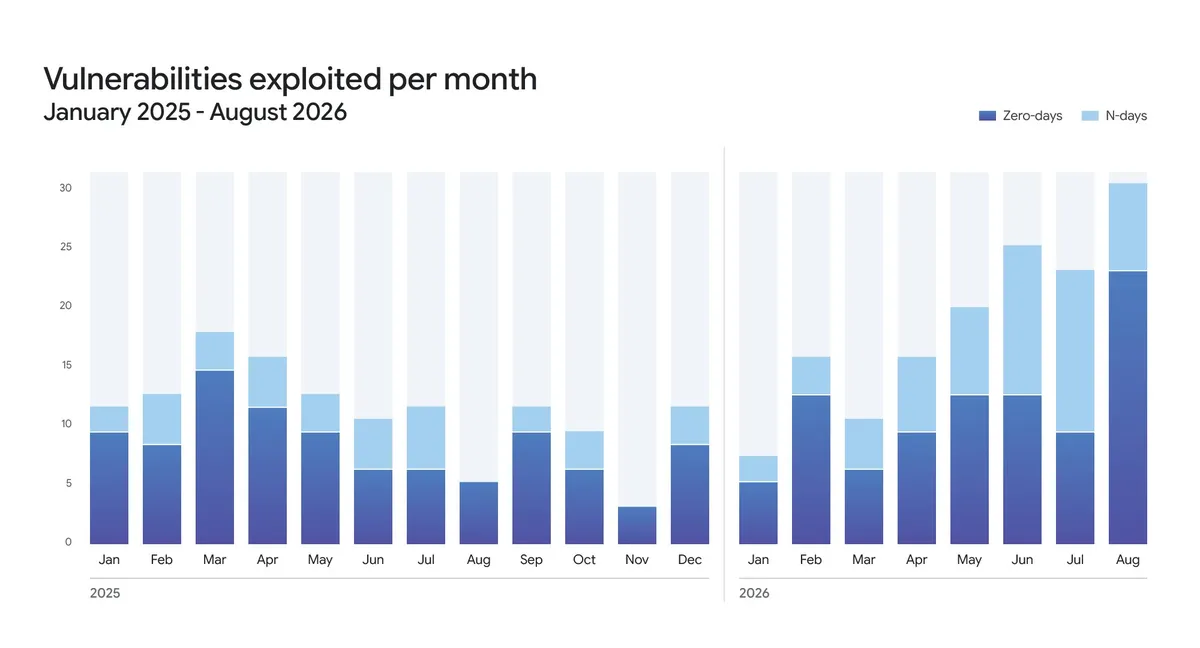
That cost is the part worth noticing. Our report on Google's finding that attackers now use AI to exploit bugs showed the same tools working for the other side. Calif's own line is that "the best hacker today is neither AI nor human," meaning a person steering the model.
What to watch next: whether the vendors behind the affected apps, such as Atlassian and Jenkins, publish their own notices, and whether anyone reports the bug being used in attacks before servers are patched.