Key takeaways
- GPT-6.2 Astra costs $8 per million input tokens and $40 per million output tokens, four times GPT-6.2 Sol's $2 and $10.
- Both models have a 1,050,000-token context window, 128,000 output tokens, the same tools and the same rate limits.
- Astra leads on most of OpenAI's tests, but on FrontierCode 2.0 Sol nearly matches it at about one-fifth of the cost per task.
The answer to GPT-6.2 Astra vs Sol is simple: Astra is the stronger model and Sol is the cheaper one. Astra costs $8 per million input tokens and $40 per million output tokens, four times Sol's $2 and $10, while both read the same 1,050,000-token context and write up to 128,000 tokens. OpenAI's own charts put Astra ahead on most tests, but on its coding benchmark Sol comes close for a fraction of the cost per task. OpenAI released both on November 17, 2026 (announcement), and our news article covers the launch.
The short version: use Sol by default, and switch to Astra for the long, hard jobs where a better answer is worth paying four times as much per token. That is also how OpenAI frames it. The API docs say to use Astra "for the most demanding tasks" and Sol "for complex work at lower cost."
This comparison is based on OpenAI's docs and the results OpenAI and Artificial Analysis published, not on hands-on testing.
GPT-6.2 Astra vs Sol at a glance
Prices and limits as of November 17, 2026, from OpenAI's model pages for Astra and Sol.
| GPT-6.2 Astra | GPT-6.2 Sol | |
|---|---|---|
| API model ID | gpt-6.2-astra |
gpt-6.2-sol |
| What OpenAI calls it | "Our most capable model for your hardest projects" | "Our go-to model for everyday work" |
| Input, per 1M tokens | $8.00 | $2.00 |
| Cached input, per 1M tokens | $0.40 | $0.10 |
| Output, per 1M tokens | $40.00 | $10.00 |
| Over 272K input tokens | $16 in, $60 out | $4 in, $15 out |
| Context window | 1,050,000 tokens | 1,050,000 tokens |
| Max input / max output | 922,000 / 128,000 | 922,000 / 128,000 |
| Knowledge cutoff | May 18, 2026 | June 1, 2026 |
| Input and output | Text and images in, text out | Text and images in, text out |
| Rate limit, top Standard tier | 15,000 requests and 40M tokens a minute | 15,000 requests and 40M tokens a minute |
| In ChatGPT and Codex | Plus, Pro, Enterprise, Edu | Plus, Pro, Enterprise, Edu |
| Ultrafast in ChatGPT and Codex | Pro $500 only | Pro $200 and Pro $500 |
Almost everything except price and quality is the same. Both models support the Responses API, Chat Completions and Batch, the same built-in tools (web search, file search, code interpreter, computer use, MCP, hosted shell and others), structured outputs and prompt caching. Neither supports fine-tuning, audio or video.
How much GPT-6.2 Astra and Sol cost
Astra costs exactly four times as much as Sol on every line of the price list: input, cached input, output and cache writes ($10 vs $2.50 per million tokens for a 30-minute cache).
Both follow the same rules for the extras, so the ratio holds there too:
- Long prompts. Once a request goes over 272,000 input tokens, input and cache prices double and output costs 1.5 times as much, for the whole request.
- Batch. Half the standard price, for jobs that can wait.
- Background completion windows. A public beta in the Responses API, added the same day, that takes 30% off for a two-hour window and 40% off for an eight-hour one, according to the API changelog.
- Fast and Ultrafast. Fast mode costs twice the standard rate. Ultrafast costs three times the standard rate through February 28, 2027, and six times from March 1, 2027.
For context, Sol keeps the price of GPT-6.1 Sol ($2 and $10), and Astra is cheaper than GPT-6 Astra, which OpenRouter lists at $10 and $50.
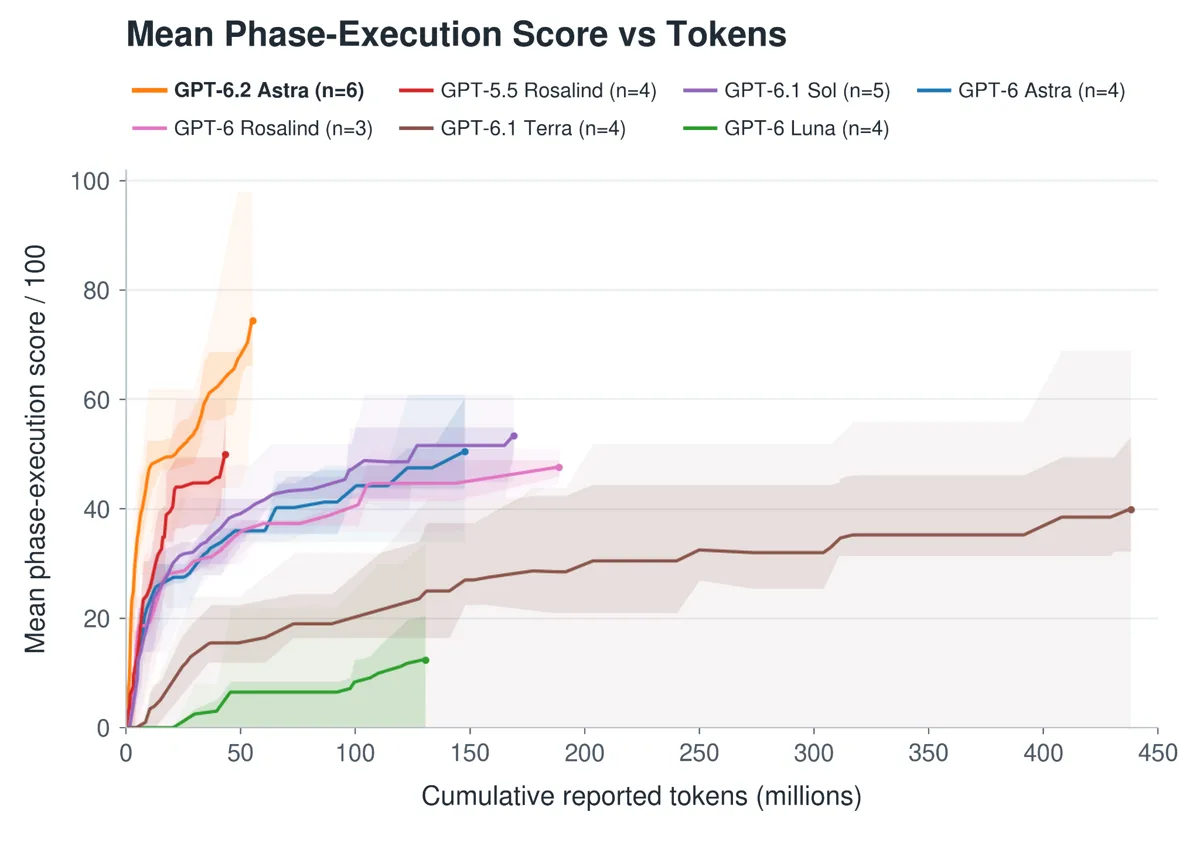
Price per token is only half of the bill. A model that thinks longer spends more output tokens on the same task. That is why OpenAI reports cost per task in its charts, and why on some of them Astra at its lowest setting costs less per task than Sol at its highest.
Which is better: benchmark results
OpenAI published charts with the launch, in a post on its developer forum that mirrors the announcement, but they plot score against cost without printing exact scores. The exact numbers for both models are in the GPT-6.2 system card:
| Test (OpenAI's results) | What it tests | GPT-6.2 Astra | GPT-6.2 Sol |
|---|---|---|---|
| GPQA Diamond, no tools | Graduate-level science questions | 97.0% | 96.0% |
| ExploitBench Internal Port | Turning known browser bugs into working exploits | 53.5% | 50.5% |
| SEC-Bench Pro | Security vulnerability tasks | 86.75% | 88.34% |
| MLE-Bench Revised | Machine-learning engineering contests, mean percentile | 96.06 | 91.38 |
| NanoGPT speedrun | Share of baseline training time saved | 42.87% | 14.59% |
| Internal Research Debugging | Fixing bugs in real research code | 81.85% | 74.66% |
Astra leads on most of them, but the gaps are what matter for choosing:
- Agents and science. OpenAI says Astra scores 5.2 points above GPT-6 Astra on Agents' Last Exam, a test of long multistep agent tasks.
- Coding. On FrontierCode 2.0, which checks whether changes to real codebases are good enough to merge, OpenAI says Sol "nearly matches Astra" at about one-fifth of the cost.
- Research work. The biggest gap is on AI research tasks: Astra saved nearly three times as much training time as Sol on NanoGPT. That gap is why OpenAI rates only Astra "High" for AI self-improvement.
- Cyber. Both models are close on exploit and vulnerability tests, and Sol is ahead on SEC-Bench Pro. OpenAI rates both "Critical" for cybersecurity and launches them with tighter safeguards on higher-risk security requests.
All of these tests come from OpenAI, and several are internal. Treat them as the company's claims.
The first independent numbers point the same way. On November 17, Artificial Analysis posted capability scores for both models at their "Max" setting. Astra scored 4 to 6 points higher on each of its six indexes: 67 vs 61 in engineering, 63 vs 59 in strategy and operations, 61 vs 57 in finance and accounting, 61 vs 57 in economics, 59 vs 55 in legal, and 57 vs 53 in healthcare.
This matters less than it looks for most work. A steady 4 to 6 point lead is real, but it costs four times as much per token. For chat, writing, routine coding and agents that run at volume, Sol gives most of the quality for a quarter of the price. Astra earns its price on long tasks where one failed run costs more than the tokens.
When to use GPT-6.2 Astra and when to use Sol
OpenAI's Codex changelog is the plainest guide. It says to choose Sol for everyday coding, writing and multistep workflows, and Astra for harder projects, such as implementing and testing a change across an existing codebase. It also says Sol completes more tasks on the same paid plan than GPT-6.1 Sol did.
Pick GPT-6.2 Sol when:
- You run agents or pipelines at volume and the bill matters.
- The work is coding, writing or analysis that a strong model already gets right most of the time.
- You want Ultrafast on a Pro $200 plan, which only Sol offers.
Pick GPT-6.2 Astra when:
- The task is long and hard: a multi-file change with tests, a research project, a long legal or financial document.
- A wrong answer is expensive, and paying more per task is cheaper than checking or redoing the work.
- You want shorter answers. OpenAI's guide says Astra is more concise and direct by default.
GPT-6.2 Astra and Sol in ChatGPT and Codex
Both models are in ChatGPT Work and Codex for Plus, Pro, Enterprise and Edu users, according to OpenAI's forum post. Ultrafast mode differs by plan: Pro $500 subscribers can use it with both models, and Pro $200 subscribers get it with Sol only. OpenAI has not published usage limits for either model in ChatGPT.
The Pro versions on OpenRouter
OpenRouter also lists "GPT-6.2 Astra Pro" and "GPT-6.2 Sol Pro." These are not separate models. OpenRouter describes each as the same model served with reasoning.mode set to pro, at the same per-token price as the base model. Pro mode uses far more tokens per answer, so each request costs more.
What to watch
Artificial Analysis and the other leaderboards are still adding scores, and OpenAI's coding claim for Sol is the one most worth checking against outside tests. OpenAI also says it is working to bring both models to Daybreak, its program for approved security teams, with fewer refusals. For the full price list across companies, see our AI API pricing page, and for the previous generation, GPT-6.1 Sol vs Terra.
Frequently asked questions
When was GPT-6.2 Sol released?
OpenAI released GPT-6.2 Sol together with GPT-6.2 Astra on November 17, 2026, in ChatGPT Work, Codex and the API.
Is GPT-6.2 Astra available in ChatGPT?
Yes. Both GPT-6.2 Astra and Sol are in ChatGPT Work and Codex for Plus, Pro, Enterprise and Edu users. Ultrafast mode with Astra needs the Pro $500 plan or an eligible Enterprise or Edu workspace.
How much does the GPT-6.2 Sol API cost?
As of November 17, 2026, GPT-6.2 Sol costs $2 per million input tokens, $0.10 for cached input and $10 per million output tokens. Prompts over 272,000 tokens cost $4 in and $15 out, and Batch is half price.
Is there a GPT-6.2 Luna?
OpenAI announced only Astra and Sol in the GPT-6.2 series on November 17, 2026. The newest Luna model in the API is still GPT-6 Luna, which OpenRouter lists at $0.10 per million input tokens.
Sources
- Introducing GPT-6.2 Astra and SolOpenAI
- GPT-6.2 Astra and Sol are now availableOpenAI Developer Community
- GPT-6.2 Astra model pageOpenAI
- GPT-6.2 Sol model pageOpenAI
- Using the latest modelOpenAI
- API changelogOpenAI
- Codex changelogOpenAI
- GPT-6.2 Astra on OpenRouterOpenRouter
- GPT-6.2 Sol on OpenRouterOpenRouter
- Artificial Analysis capability indexesArtificial Analysis