Key takeaways
- A Malspark scan on November 26 found five malicious GGUF models on Hugging Face from two accounts, Mir2k and timdedid.
- Two models hid a Windows remote access program; three used chat templates to tell AI agents to download and run a script.
- By November 28 Hugging Face had disabled all five, after 2,807 downloads by its own count.
Hugging Face has disabled five malicious GGUF models that a security researcher found carrying malware. The researcher, writing on the security blog Malspark on November 27, found the five models in a scan of 3,273,389 public model repositories on Hugging Face. The models were downloaded 2,428 times by November 27, according to the post, and Hugging Face's own counters showed 2,807 downloads on November 28.
The case is a warning about malware in GGUF files, the single-file format that llama.cpp, Ollama and LM Studio use to run models locally. GGUF holds weights and settings, not code, so many people treat it as the safe choice. These attacks didn't break that assumption. They used two things the format does carry: extra bytes after the weights, and a chat template that tells the model what to say.
How the malicious GGUF models worked
The post describes two campaigns, both posing as "uncensored" or "abliterated" versions of popular open models.
The first account, Mir2k, uploaded two models: Huihui-Qwen3.5-9B-abliterated-GGUF and Inkling-2-Mini-Uncensored-GGUF. Each file hid a Windows remote access program, which the researcher calls "ollie", after the last tensor of the model. On November 26 the account changed both chat templates. The new template told the model to start every reply with one PowerShell line. A user who copied and ran that line would pull the hidden program out of the model file and start it. The post says the program can steal saved browser passwords, target the Phantom and MetaMask crypto wallets, log keystrokes and mine Monero.
The second account, timdedid, uploaded three small Qwen3-based models. Their template waited for a user message containing "What is". It then inserted a hidden instruction telling an AI agent with shell access to download a script from a WordPress site and run it in a hidden window. The researcher could not recover that script, so what it does is unknown.
Hugging Face disabled the repositories
All five were still online when the post went up on November 27. By the evening of November 28, each page read "Access to this model has been disabled" and said the content breaks Hugging Face's content policy. The repositories still exist, but their files can no longer be downloaded. Hugging Face has not published a statement on the case.
| Repository | Downloads (Hugging Face count, Nov 28) |
|---|---|
| Mir2k/Huihui-Qwen3.5-9B-abliterated-GGUF | 1,711 |
| Mir2k/Inkling-2-Mini-Uncensored-GGUF | 574 |
| timdedid/qwen3.8-cyber-uncensored | 288 |
| timdedid/qwen3-cyber-UNCENSORED-2 | 151 |
| timdedid/qwen3-cyber-UNCENSORED | 83 |
Hugging Face counts downloads, not people, so the number of people affected is lower than these totals. The post also names a timdedid mirror on Ollama, qwen3-1.7b-cyber.
Who is at risk
Downloading one of these files did not infect a computer by itself. For the Mir2k models, someone had to copy and run the PowerShell line the model printed, and files downloaded before November 26 had the hidden program but not the template that pointed to it. For the timdedid models, the risk was an agent with permission to run commands, which would follow the hidden instruction without the user seeing it.
The researcher's advice: delete any of these files, check for the signs the post lists (a scheduled task that runs every 10 minutes, folders named "ollie" under AppData\Roaming, a d.exe file in the temp folder), and rebuild a machine where the line was run. The post also says common antivirus tools missed the compressed payload.
The wider lesson is about chat templates. A GGUF file's template is text the runtime trusts, and these attacks turned it into a prompt injection that ships inside the model. llama.cpp and Ollama both let users supply their own template instead of the embedded one. Our explainer on what GGUF is covers how the format stores it.
What to watch
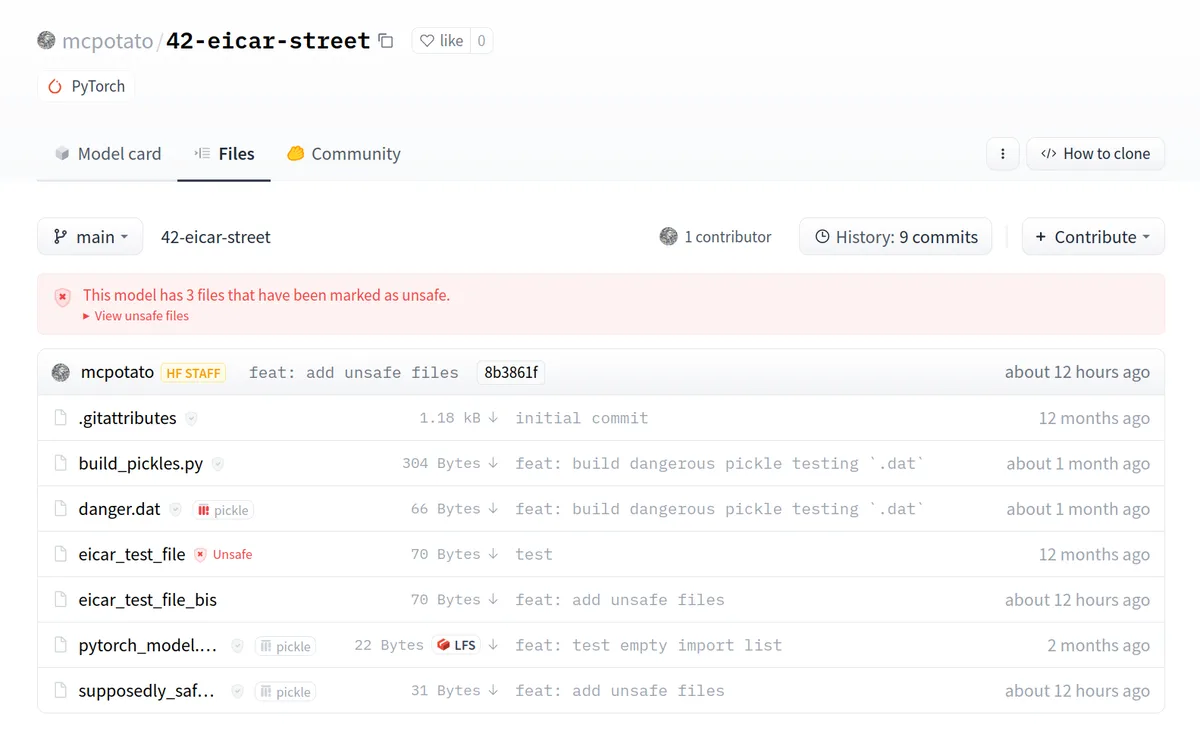
The post lists further indicators and a scanning tool for local .gguf files. Hugging Face runs every file under 2 GB through the ClamAV malware scanner at each commit, and both accounts stayed up for several days. Whether it starts checking GGUF templates and trailing bytes is the next thing to watch.
Sources
- Malicious GGUF models on Hugging FaceMalspark
- Mir2k/Huihui-Qwen3.5-9B-abliterated-GGUF (disabled)Hugging Face
- Malware scanningHugging Face
- Content policyHugging Face