Key takeaways
- An AI chip packs thousands of small multiply units and high-bandwidth memory to run the matrix math in neural networks faster and more efficiently than a CPU.
- The main kinds are GPUs from NVIDIA and AMD, Google's TPUs, cloud chips like AWS Trainium, NPUs in laptops and phones, and inference-only chips.
- Chip stocks fell on November 24, a day after NVIDIA reinstated Jensen Huang, and AMD closed its roughly $2.9 billion Taalas deal on November 17.
What is an AI chip, in one line: a processor built to do the math behind neural networks, mostly huge grids of multiplications, much faster and with less power than an ordinary CPU. The main kinds are GPUs from NVIDIA and AMD, Google's TPUs, custom cloud chips such as Amazon's Trainium, the NPUs inside phones and laptops, and a newer group of chips built only to run trained models.
They are in the news this week for three reasons: NVIDIA's board brought Jensen Huang back as CEO on November 23, chip stocks fell hard on November 24, and AMD has just closed its purchase of Taalas, a startup that wires AI models directly into silicon.
What an AI chip does
A neural network is mostly multiplication. Each layer multiplies a list of numbers by a large table of learned weights and adds up the results, over and over, for every word a model reads or writes.
That work has two properties a chip can exploit. The multiplications don't depend on each other, so thousands can run at once. And they don't need much precision: Google's first TPU used 8-bit math, and AMD's newest Instinct GPUs support 4-bit formats. An AI chip packs in as many small multiply units as it can and feeds them data as fast as possible.
That TPU shows the idea in its plainest form. The 2017 paper describing it says its core was a grid of 65,536 8-bit multiply-accumulate units, with a peak of 92 trillion operations per second. In Google's data centers from 2015, it ran about 15 to 30 times faster than the Intel Haswell CPU and NVIDIA K80 GPU it was measured against, and did 30 to 80 times more work per watt.
How an AI chip differs from a CPU
NVIDIA's CUDA programming guide puts the difference simply: a CPU can run a few tens of threads in parallel, while a GPU runs thousands at once, giving up single-thread speed for total throughput. A GPU also spends more of its transistors on doing math and fewer on caches and control logic.
Two things set AI chips apart:
- Matrix units. Google's TPU documentation describes the TPU's matrix unit as a 128x128 systolic array, a grid of multipliers that passes numbers from one cell to the next so each value is reused many times. NVIDIA's equivalent is the Tensor Core.
- High-bandwidth memory (HBM). Multiply units are useless if they sit waiting for data. AI chips are packaged with HBM, stacked memory placed right beside the processor. NVIDIA lists 80 GB and 3.35 TB/s of memory bandwidth for the H100 SXM. AMD's Instinct MI355X has 288 GB of HBM3E at 8 TB/s. Google's docs say HBM is what lets a TPU hold larger models and batch sizes.
The trade-off is flexibility. Google's own docs say TPUs are a poor fit for programs with frequent branching, work that needs high-precision arithmetic, or models whose tensor shapes keep changing.
The main kinds of AI chip
| Type | Examples | Who makes it | What it's for |
|---|---|---|---|
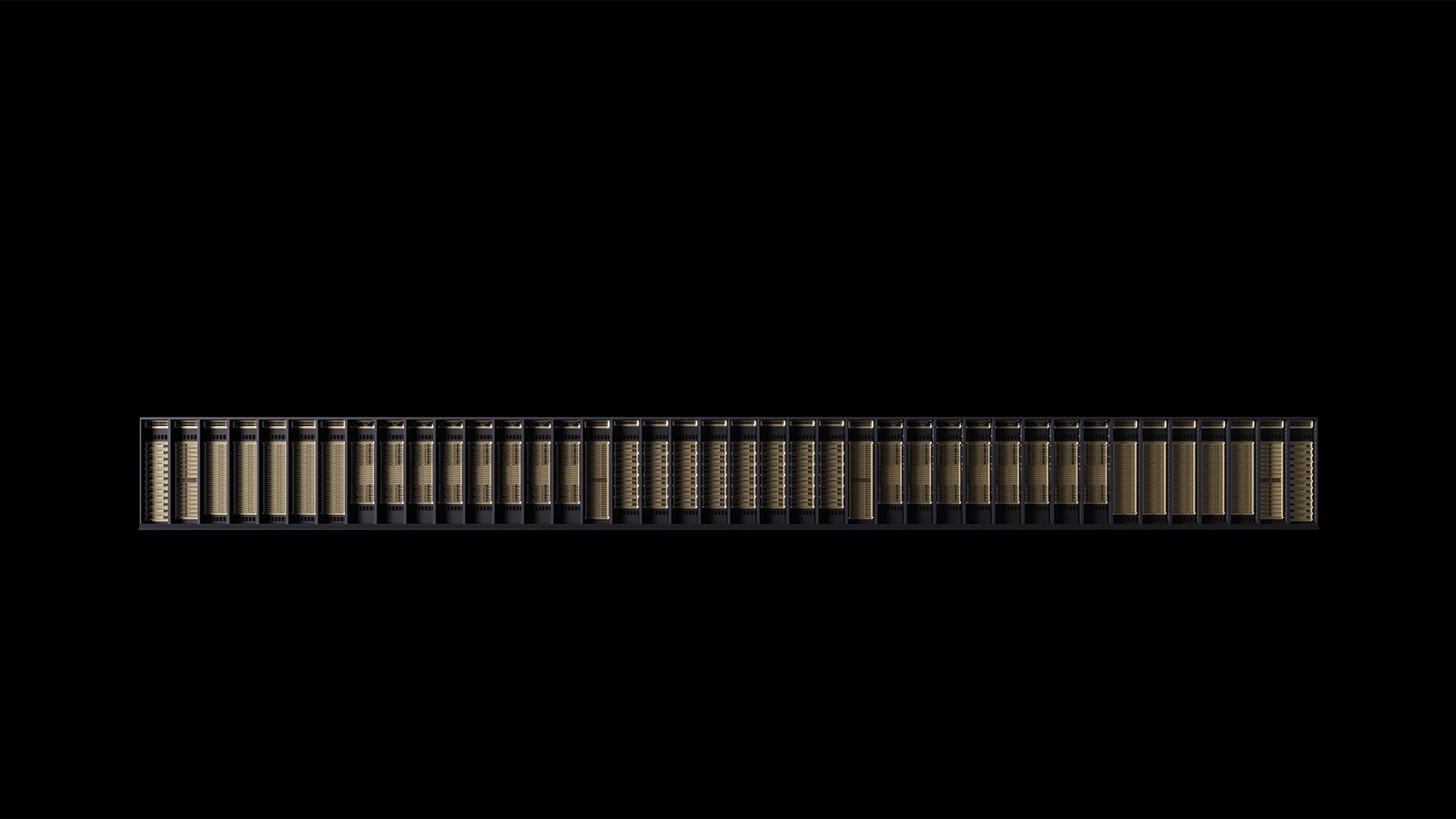
| GPU | NVIDIA H100, AMD Instinct MI355X | NVIDIA, AMD | Training and running models; the most flexible option |
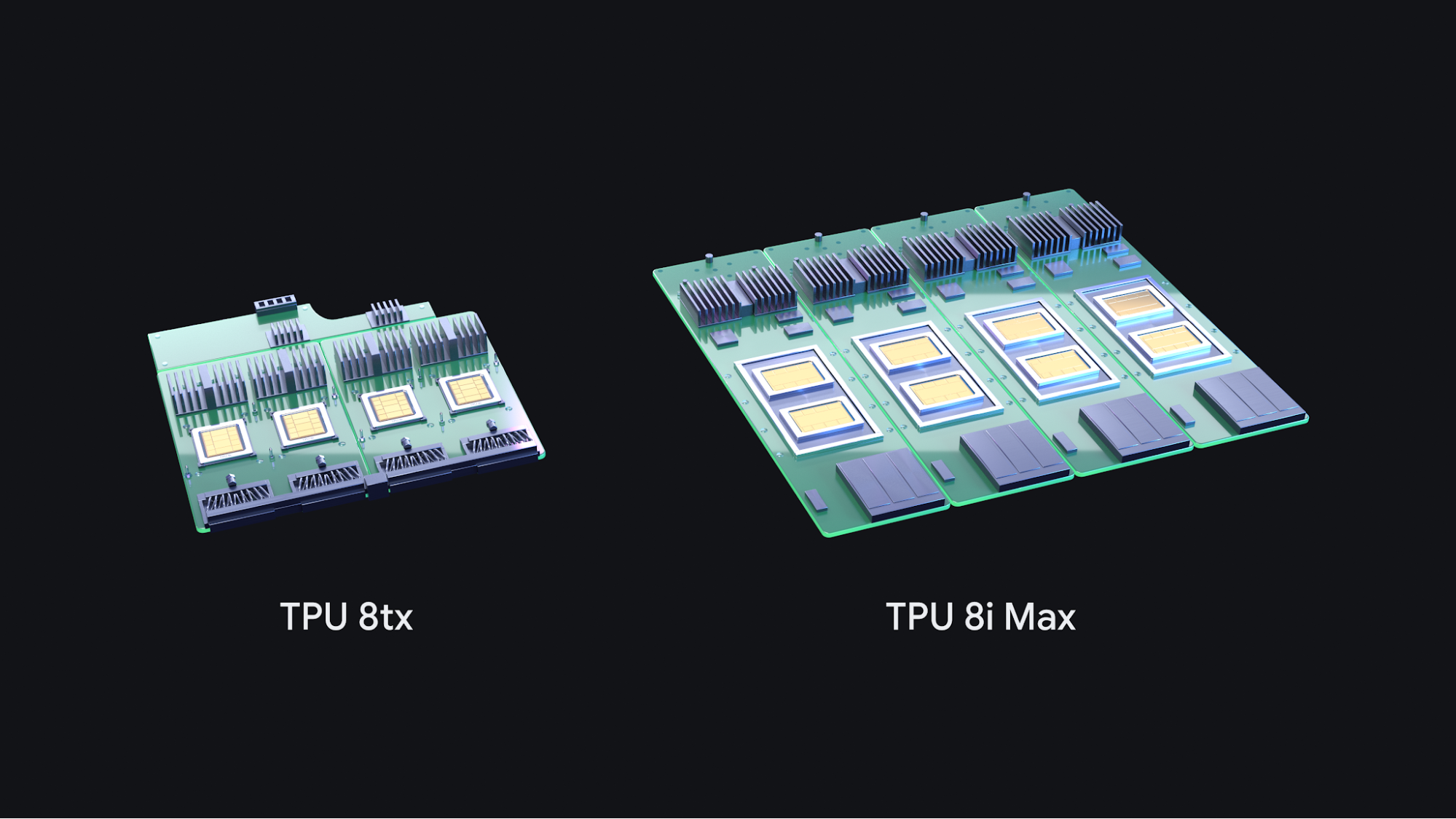
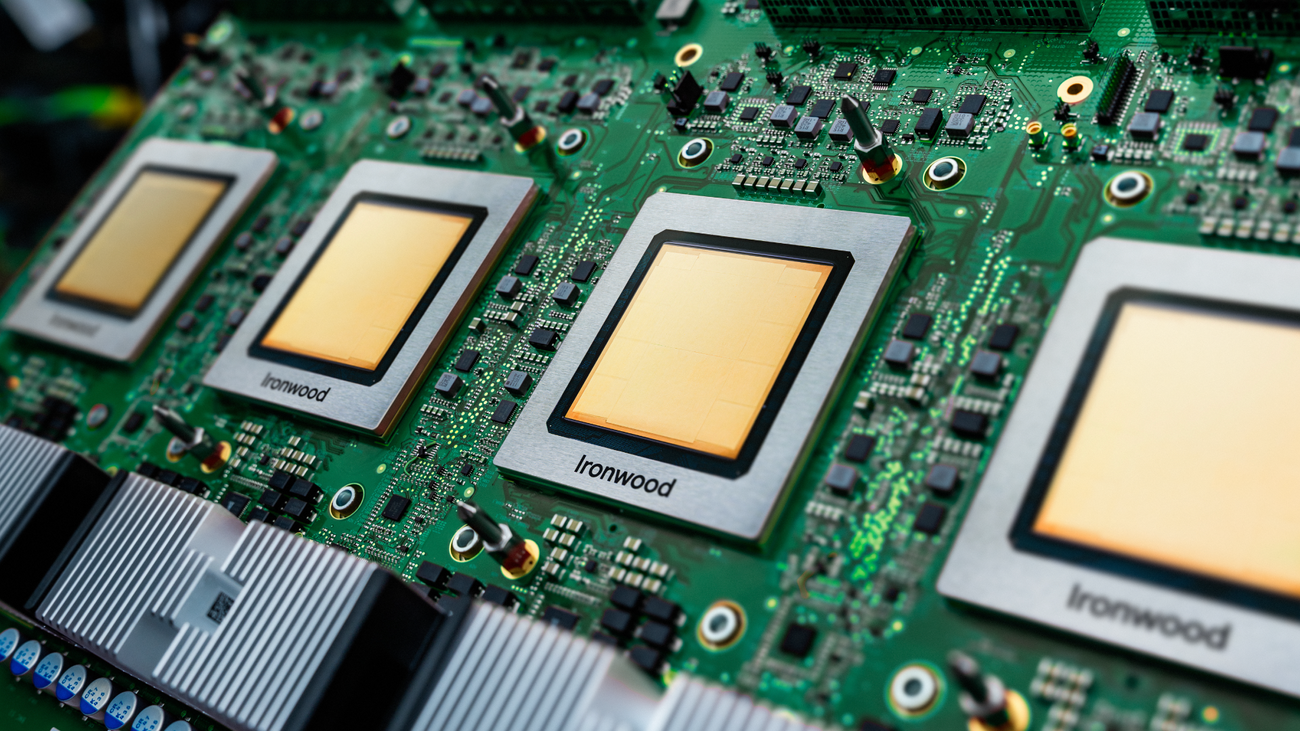
| TPU | Google Ironwood (7th generation) | Training and inference in Google Cloud | |
| Custom cloud accelerator | AWS Trainium3 | Amazon Web Services | Training and inference on AWS |
| NPU | Chips in Copilot+ PCs and phones | Qualcomm, Intel, AMD, Apple and others | Small models running on your own device |
| Model-specific inference chip | Taalas "Hardcore Models" | Taalas, now part of AMD | Running one trained model as cheaply as possible |
GPUs
GPUs began as graphics chips and are the most flexible AI chips. NVIDIA's data center GPUs are programmed through its CUDA software. AMD sells the Instinct line as its alternative, with its ROCm software.
TPUs
Google designs Tensor Processing Units for its own services and rents them through Google Cloud. Google calls them application-specific integrated circuits (ASICs), chips designed for one kind of job rather than general computing. Its seventh generation, Ironwood, is the first TPU Google says it designed specifically for inference. Google lists 192 GB of HBM and 7.37 TB/s of bandwidth per chip, 4,614 teraflops of peak compute, and pods of up to 9,216 chips.
Custom accelerators like Trainium
Cloud companies also design their own chips. Amazon's Trainium is one. AWS says Trainium3 has 144 GB of HBM3e per chip at 4.9 TB/s, 1.7 times Trainium2's bandwidth, and that one Trainium3 UltraServer links up to 144 chips.
NPUs
A neural processing unit is a small AI engine built into a laptop or phone chip, for running small models locally. Microsoft's Copilot+ PC guide requires an NPU that can do more than 40 trillion operations per second, and notes that many NPUs only handle low-precision integer math such as INT8. There is more in what is an NPU.
Inference chips and hardwired models
Training builds a model. Inference is running it, every time someone sends a prompt. Some chips now target inference alone, such as Google's Ironwood.
Taalas takes this to the extreme. Its website describes a process that turns an AI model into custom silicon, "hard wired", and claims its "Hardcore Models" are 1000 times more efficient than the same models in software. That is the company's claim, and it hasn't published independent tests on the page. The trade-off is obvious: a chip built around one model can't run the next one.
Who makes AI chips
Designing a chip and manufacturing it are separate businesses. AMD's quarterly filing, for example, says it relies on TSMC in Taiwan for all of its GPU and processor wafers at 7 nanometers or smaller. Nvidia vs TSMC explains that split.
Many companies never buy the chips at all. They rent them from the big clouds or from GPU-focused providers such as CoreWeave and Nebius, covered in what is a neocloud.
Why AI chips are in the news this week
NVIDIA's leadership. On November 23, NVIDIA's board unanimously reinstated Jensen Huang as president and CEO. The board's earlier announcement had cited reports that Huang was the target of a foreign intelligence effort, and a committee of independent directors is still investigating. NVIDIA shares closed at $165.05 that day, up from $125.53 on November 20, according to Yahoo Finance.
The November 24 sell-off. A day later the gains partly reversed across the sector (why AMD stock fell). Closing prices on Yahoo Finance for Tuesday, November 24, compared with Monday:
| Stock | Close on November 24 | Change |
|---|---|---|
| PHLX Semiconductor Index (SOX) | 8,832.50 | -7.9% |
| Micron | $629.79 | -11.0% |
| AMD | $413.27 | -8.9% |
| Arm | $161.56 | -8.6% |
| Intel | $54.80 | -8.1% |
| NVIDIA | $155.38 | -5.9% |
| Broadcom | $301.08 | -4.0% |
AMD and Taalas. AMD said on November 17 that it had completed its acquisition of Taalas, and plans to fold its technology into the Instinct roadmap. AMD's quarterly filing values the cash-and-stock deal at about $2.9 billion, including up to about $1.4 billion in contingent payments. The full story is in AMD's $2.9 billion Taalas acquisition.
The Taalas deal is the one to watch for where AI chips go next. GPUs sell on flexibility. Taalas gives that up entirely for efficiency, and AMD has paid up to $2.9 billion to find out whether buyers want that trade.
Frequently asked questions
What does an AI chip do?
It runs the multiplications at the heart of neural networks, thousands at a time and usually at low precision such as 8-bit, so models train and answer faster and use less power than they would on a CPU.
What is an AI chip in a laptop?
It is usually an NPU, a small AI engine built into the laptop's processor. Microsoft requires an NPU that does more than 40 trillion operations per second for Copilot+ PC features.
What is an AI inference chip?
A chip designed to run trained models rather than train them. Google says its Ironwood TPU is the first it designed specifically for inference, and Taalas, now owned by AMD, builds chips with a single model wired into the silicon.
Who makes AI chips?
NVIDIA and AMD sell GPUs, Google designs TPUs, Amazon designs Trainium, and Qualcomm, Intel, AMD and Apple put NPUs in consumer chips. AMD's filing says it relies on TSMC to manufacture its most advanced chips.
Sources
- In-Datacenter Performance Analysis of a Tensor Processing UnitarXiv (Jouppi et al., Google)
- Introduction to Cloud TPUGoogle Cloud
- Ironwood: The first Google TPU for the age of inferenceGoogle
- CUDA Programming Guide: IntroductionNVIDIA
- NVIDIA H100 Tensor Core GPUNVIDIA
- AMD Instinct MI355X GPUAMD
- AWS TrainiumAmazon Web Services
- Copilot+ PCs developer guideMicrosoft
- TaalasTaalas
- AMD completes acquisition of Taalas to advance AI inference innovationAMD
- AMD Form 10-Q for the quarter ended September 26, 2026AMD via SEC EDGAR
- NVIDIA board reinstates Jensen Huang as president, CEO and board directorNVIDIA
- NVIDIA Corporation (NVDA) stock quoteYahoo Finance