Key takeaways
- An NPU is a part of a chip built only to run AI models, doing their multiply-and-add math in parallel at low power.
- Vendors rate NPUs in TOPS, trillions of operations per second, usually at INT8 precision and peak clock speed.
- Microsoft says many Windows AI features on Copilot+ PCs require an NPU that runs at more than 40 TOPS.
What is an NPU, in short: a neural processing unit, the part of a chip built only to run AI models. It does the multiply-and-add math that neural networks are made of, in parallel and at low power, so a phone or laptop can run AI features itself instead of sending the work to a data center. Microsoft's developer guide calls it "a specialized computer chip for AI-intensive processes like real-time translations and image generation."
Apple calls its NPU the Neural Engine, Qualcomm calls its the Hexagon NPU, and Intel and AMD build NPUs into their laptop processors. Microsoft's Copilot+ PCs are defined by having one that runs at more than 40 trillion operations per second.
What an NPU does
A neural network is mostly one operation repeated billions of times: multiply two numbers and add the result to a running total. Chip makers call this a multiply-accumulate, or MAC. Running a trained model to get an answer, called inference, is mostly MACs plus moving numbers in and out of memory. (Our explainer on what AI inference is covers that step.)
A CPU or GPU can do this math too. An NPU is built to do only this, with arrays of math units working in parallel. Microsoft says it uses energy on AI tasks more efficiently than a CPU or GPU, which means longer battery life.
Two design choices show up again and again:
- Small numbers. Models are often trained with 32-bit floating-point numbers. Many NPUs, Microsoft notes, "only support integer math in lower bit format, such as INT8," for speed and power efficiency. Models are converted, or quantized, to that format before they run on the NPU.
- Keeping data close. Qualcomm's Hexagon NPU page describes a large shared memory between its scalar, vector and tensor units, and a technique it calls micro-tile inferencing that runs 10 or more layers of a network together to avoid "almost all the intermediate memory reads and writes."
The approach was proven in data centers first. Google's 2017 paper on its first Tensor Processing Unit described an inference chip with 65,536 8-bit MAC units and a peak of 92 trillion operations per second. Against a server CPU and GPU of the time, the authors measured it as 15 to 30 times faster and 30 to 80 times more efficient per watt. NPUs apply the same trade to a phone or laptop power budget.
NPU vs CPU, GPU and TPU
The NPU doesn't replace the other processors. It sits on the same chip and takes the AI work. Qualcomm sums up the split: the CPU is for "sequential control and immediacy," the GPU for "streaming parallel data," and the NPU for "core AI workloads."
| Processor | Built for | Where you find it | Strength for AI |
|---|---|---|---|
| CPU | Running any program, one step after another | Every computer and phone | Flexible, runs the code around a model |
| GPU | Graphics and other parallel math | Phones, laptops, data centers | High throughput on large parallel jobs |
| TPU | Neural network math in Google's data centers | Google Cloud | AI work at data-center scale |
| NPU | Running neural networks at low power on a device | Phones, tablets, "AI PCs" | AI features without draining the battery |
A TPU is Google's own AI accelerator for data centers. An NPU is the general term for the small accelerator in a consumer device. Both are built around arrays of multiply-accumulate units. Our pieces on what a TPU is and how TPUs and GPUs differ cover the data-center side.
Software decides which processor runs what. On Apple devices, Core ML builds a hybrid execution plan across the CPU, GPU and Neural Engine. On Windows, Windows ML finds the NPU, loads the software layer for that chip, and falls back to the GPU or CPU when the NPU can't run a model.
What runs on an NPU
- On iPhone, iPad and Mac. Apple's Neural Engine research note lists Face ID, Memoji, scene analysis in Photos, image captions for accessibility and machine translation. In one test there, a DistilBERT language model tuned for the Neural Engine ran in 3.47 milliseconds at 0.454 watts on an iPhone 13.
- On Copilot+ PCs. Microsoft's launch post of May 20, 2024 named Recall, Cocreator image generation, Live Captions with translation from more than 40 languages into English, and Windows Studio Effects for video calls.
How NPUs are measured: TOPS
Vendors rate NPUs in TOPS, trillions of operations per second. Qualcomm's guide to TOPS, reprinted with its permission, gives the formula: TOPS = 2 × number of MAC units × clock frequency ÷ 1 trillion. The 2 is there because each MAC counts as a multiply and an add.
Before comparing numbers:
- Precision. Qualcomm says the industry standard is to quote TOPS at INT8. Check that two figures use the same number format.
- Peak, not typical. Qualcomm says the figure is "generally at the peak operating frequency." AMD's footnote says it may not be typical.
- Not the whole story. Qualcomm's guide says "a high TOPS number alone does not guarantee optimal AI performance." Memory bandwidth and software also count.
Apple's numbers don't line up exactly. Its research note gives FP16 teraflops, and its chip announcements give "operations per second" without naming the number format.
NPU examples from Apple, Qualcomm, Intel and AMD
Each figure is from the company's own page.
| Chip | NPU | Vendor's figure | Announced |
|---|---|---|---|
| Apple A11 Bionic (iPhone X) | First Neural Engine | 0.6 FP16 teraflops | 2017 |
| Apple A15 Bionic (iPhone 13 Pro) | 16-core Neural Engine | 15.8 FP16 teraflops | 2021 |
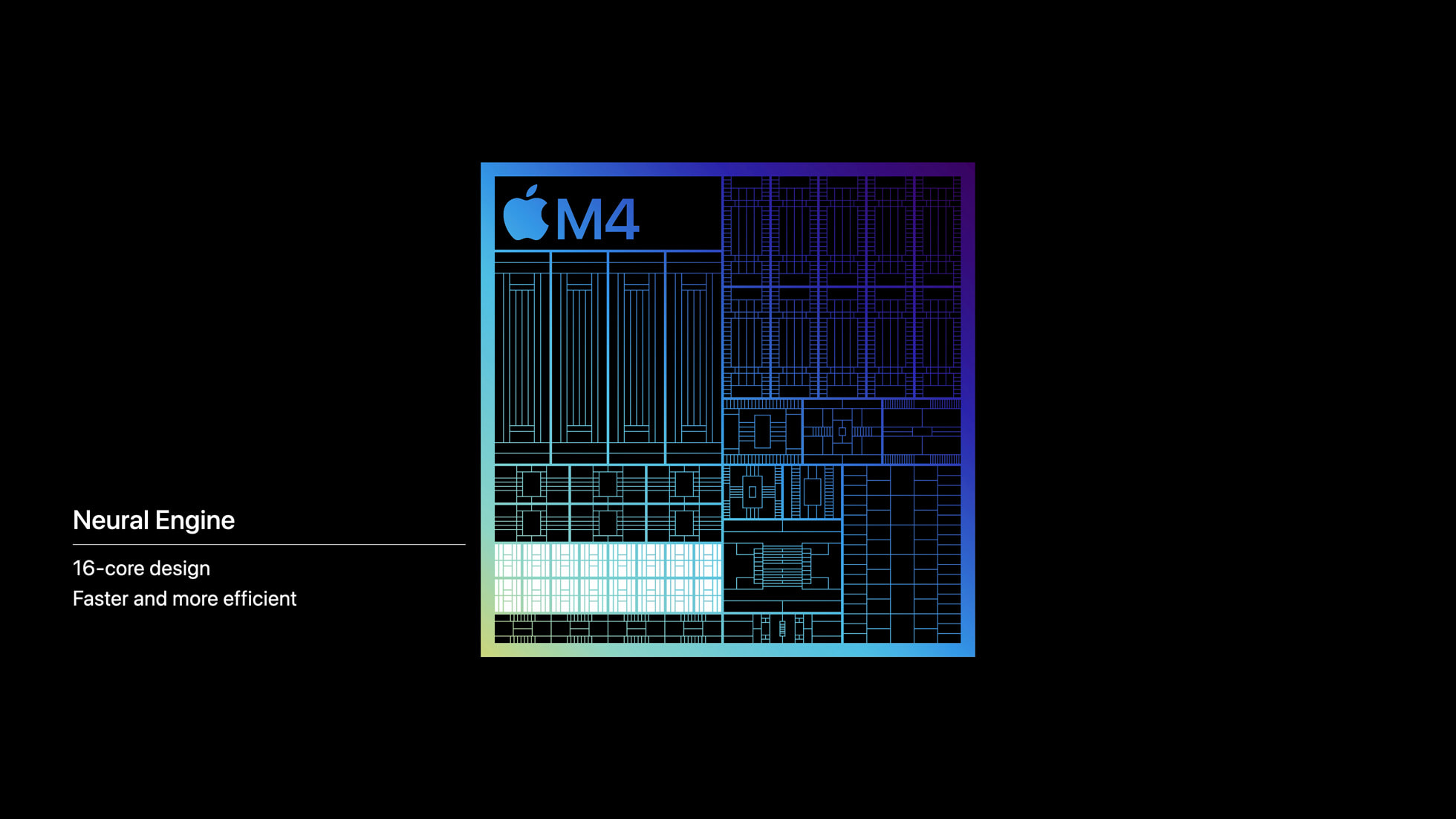
| Apple M4 | 16-core Neural Engine | 38 trillion operations per second | May 2024 |
| Qualcomm Snapdragon X Elite | Hexagon NPU | Up to 45 TOPS | Current product page |
| AMD Ryzen AI 300 series | XDNA 2 NPU | Up to 50 peak TOPS | June 2, 2024 |
| Intel Core Ultra 200V series | Fourth-generation NPU | Up to 48 TOPS | September 3, 2024 |
| Apple M5 | Improved 16-core Neural Engine | No figure given | October 15, 2025 |
Apple. Apple's M4 announcement says its Neural Engine is 60 times faster than the first one in the A11. With M5, Apple also put a "Neural Accelerator" in each of the 10 GPU cores, so AI work no longer sits only in the NPU.
Qualcomm. The Hexagon NPU grew out of a signal processor Qualcomm launched in 2007, and gained a tensor unit in the Snapdragon 855 in 2018. The Snapdragon X Elite laptop chip lists an NPU of up to 45 TOPS.
AMD. AMD announced the Ryzen AI 300 series on June 2, 2024, with an XDNA 2 NPU rated at up to 50 peak TOPS, against 16 TOPS for the Ryzen 8040 series.
Intel. Intel launched the Core Ultra 200V series on September 3, 2024. Its support page lists the NPU at up to 48 TOPS. Intel's 120 "total platform TOPS" adds up the CPU, GPU and NPU, so it isn't an NPU number.
Why Copilot+ PCs need 40 TOPS
Microsoft's guide says many new Windows AI features "require an NPU with the ability to run at 40+ TOPS." The top ratings for the Qualcomm, AMD and Intel chips above, 45, 50 and 48 TOPS, all clear it, and Microsoft lists Copilot+ PCs built on all three. On a Windows PC with an NPU, Task Manager shows it next to the CPU and GPU, which is the quickest way to check.
For most buyers, the NPU matters through the features that use it, not its TOPS number. A higher rating helps only when the software runs on the NPU, and today that mostly means features the operating system maker built for it.
Frequently asked questions
What does NPU stand for?
NPU stands for neural processing unit. It is a processor built to run neural networks, the kind of model behind most AI features.
What is the difference between an NPU and a GPU?
A GPU is built for graphics and other parallel math and can run almost any AI model at high power. An NPU is built only for neural network math, usually in small number formats like INT8, so it runs AI features using less energy.
What is an NPU used for in a laptop?
On Copilot+ PCs, Microsoft uses the NPU for features such as Recall, Cocreator image generation, Live Captions with translation and Windows Studio Effects. Apps can also target it through Windows ML.
How do I check if my PC has an NPU?
On Windows 11, open Task Manager. On PCs with an NPU, it shows the NPU and its usage next to the CPU and GPU.
Sources
- Copilot+ PCs developer guideMicrosoft
- Introducing Copilot+ PCsMicrosoft
- Deploying Transformers on the Apple Neural EngineApple
- Apple introduces M4 chipApple
- Apple unleashes M5, the next big leap in AI performance for Apple siliconApple
- Qualcomm Hexagon NPUQualcomm
- Snapdragon X EliteQualcomm
- A guide to AI TOPS and NPU performance metrics (reprinted with Qualcomm's permission)Qualcomm via Edge AI and Vision Alliance
- Intel Core Ultra 200V series mobile processorsIntel
- Intel Core Ultra processors (Series 2) support articleIntel
- AMD unveils next-gen Zen 5 Ryzen processors to power advanced AI experiencesAMD
- In-Datacenter Performance Analysis of a Tensor Processing UnitJouppi et al., Google (arXiv)