Key takeaways
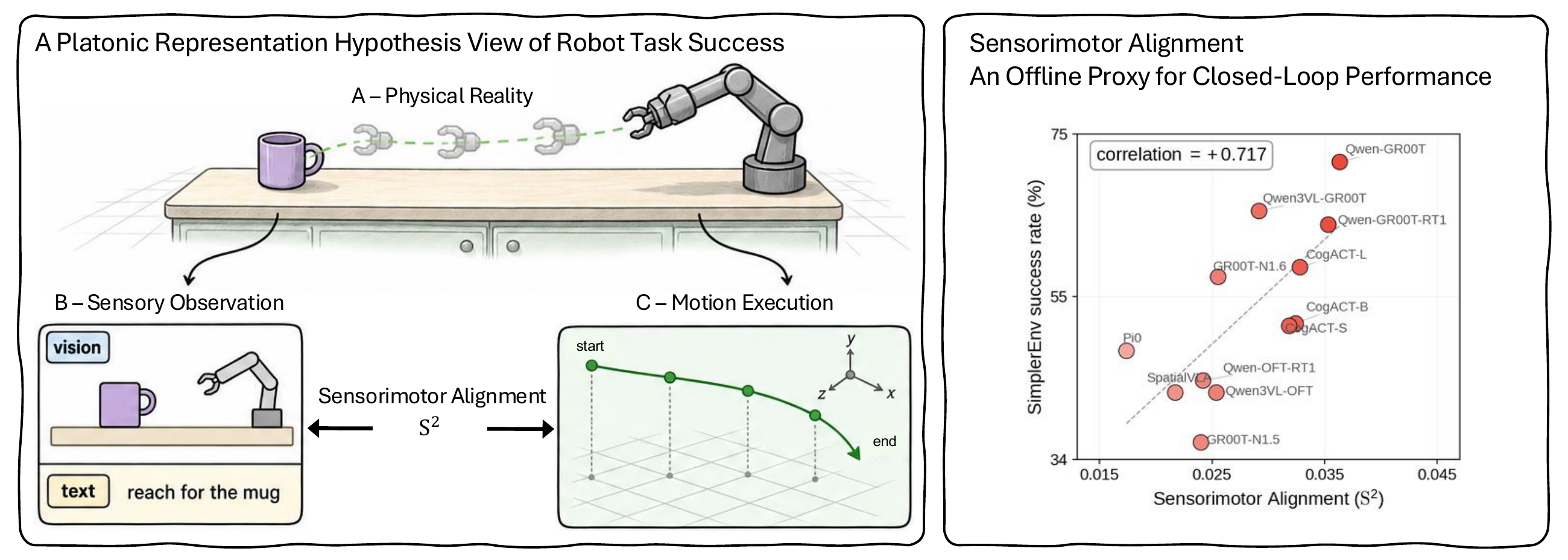
- Sensorimotor alignment (S²) is a training-free offline score that compares how a model's image and text representations line up with robot motion trajectories.
- It correlated at r = +0.717 with SimplerEnv success across 12 vision-language-action models, while a standard question-answering score gave -0.154 on 8 vision-language models.
- The authors say it is correlational and best used to screen models before closed-loop tests, and the real-robot result rests on only five policies.
Sensorimotor alignment, or S², is a score that tries to predict how well a robot model will perform without ever running the robot. A team with researchers at Rice University and NVIDIA describes it in a paper on arXiv, which was the third most upvoted paper on Hugging Face's daily list on October 29, with 20 upvotes. Across several families of models the score tracked task success with a correlation of about 0.7, but the authors say it is a screening tool, not a replacement for testing.
The problem: testing robot models is slow
A robot foundation model takes in camera images and a written instruction, such as "reach for the mug", and outputs motions. The standard way to judge one is to run it in a simulator or on a real robot and count how often the task succeeds. That is slow and expensive, and it gets worse as the number of models grows.
Cheaper proxies exist, but the paper argues they miss the point. A vision-language model (a model that reads images and text) can score well on question answering about pictures without its internal representation being useful for acting. A video-generating "world model" can be judged on how good its pixels look, which says little about whether it can steer an arm.
What S² measures
The idea borrows from the Platonic Representation Hypothesis, which says that different models, as they get better, tend to organize their internal representations in a similar way. The authors ask whether that holds between what a robot sees and how it moves. If a capable model has a good internal picture of a scene and its instruction, scenes that call for similar motions should sit close together in that picture.
The recipe has three parts, all of them run offline on existing robot data:
- Sensory side. For each recorded episode, take one image frame and the task instruction, pass them through the model's encoders, and average the result into one vector. Two episodes are close if their vectors point the same way.
- Motor side. Take the arm's next few moves: position, rotation and gripper state. Two episodes are close if their trajectories are similar, measured with dynamic time warping, a standard way to compare paths that run at different speeds.
- Alignment. Check how much the two notions of "close" agree. For each episode, the score looks at its 10 nearest neighbors on each side and measures the overlap, using a centered, normalized variant of an existing alignment measure called CKNNA.
S² needs no training and no robot. It uses the DROID dataset (95,658 episodes, with a 6,000-episode subset in the experiments) or BridgeDataV2 (53,192 episodes), and for bimanual world models, 839 trajectory windows from ALOHA.
How well it tracked success
The authors compared S² with published task success for several groups of models. The correlation figures below are Pearson's r, where 1.0 is a perfect match.
| Models | Benchmark | Correlation (r) |
|---|---|---|
| 12 vision-language-action models | SimplerEnv-WidowX | +0.717 |
| 8 raw vision-language models, against success of robot models built from them | SimplerEnv-WidowX | +0.681 |
| 6 world-action models | RoboTwin 2.0 | +0.718 |
| 14 frozen image encoders, behavior cloning | Hu et al. | +0.677 |
| 14 frozen image encoders, visual reward learning | Hu et al. | +0.774 |
| 5 policies on real robots | MolmoB0T evaluation | +0.831 |
Two comparisons stand out. On the 8 vision-language models, the usual question-answering score correlated at -0.154 with robot success, against +0.681 for S². On three world models, the common video-quality metric FID pointed the wrong way, according to the authors, while S² on ALOHA data gave +0.999.
A control test also worked as intended. Evaluating the same three bimanual world models on single-arm DROID data instead of ALOHA dropped the correlation from +0.999 to +0.246, which suggests the score depends on the reference data matching the robot.
The authors also report that freezing the vision encoder cut S² by 41% and success by 40% in one test with Qwen2.5-VL-3B models.
How much to trust it
The paper is candid about its limits, and several results are weak:
- Small samples. The real-robot result uses only five policies, with p = 0.041. Its time horizon of 110 steps was chosen after the fact, and the horizon set in advance, 7 steps, gave r = +0.429 with p = 0.236, which is not significant.
- Fading with more data. For frozen encoders, the correlation fell to +0.236 at the largest behavior-cloning demonstration budget. With reinforcement learning from task rewards, the authors found no positive correlation.
- Correlation only. S² has not been used as a training objective, so there is no evidence yet that raising it improves a robot.
- Ties it cannot break. Models with similar S² can have different success rates, so the authors recommend using it to screen candidates before closed-loop testing.
- Narrow coverage. The study has few models per comparison, a limited set of benchmarks and recipes, and one real-robot setting. Some confound checks, such as the three-model CogACT family, have too little data to be conclusive.
For a reader who builds with robot models, the practical value is as a cheap first filter: rank many checkpoints offline, then spend real robot time on the top few. For everyone else, the finding is that how a model organizes what it sees seems to carry some information about how well it can act.
Code and paper
The authors have released code on GitHub and a project page. The paper is on arXiv as 2610.31670. Watch for whether other groups reproduce the correlations on models the authors did not test.
Frequently asked questions
What is sensorimotor alignment (S²)?
It is an offline score for robot models. It checks whether episodes that look and read alike to a model also involve similar arm motions, using recorded data from datasets such as DROID, with no robot rollouts needed.
What is the Platonic Representation Hypothesis?
It is the idea that as models get more capable, their internal representations converge toward a shared structure. The S² paper extends that question from images and text to robot motion.
Can S² replace testing a robot model in simulation or on hardware?
No. The authors say models with similar S² can have different success rates, and the link to success is correlational. They recommend it as a screening step before closed-loop testing.