Key takeaways
- Nvidia released Flora, three open models that caption, segment and score robot training video.
- Nvidia says Flora is roughly 125 times cheaper than GPT-6 Astra and labels 200,000 hours of data a day on 512 GB300 GPUs.
- On Nvidia's own benchmarks Flora wins some tests, including failure recall, and loses others to GPT-5.6 Sol and GPT-6 Astra.
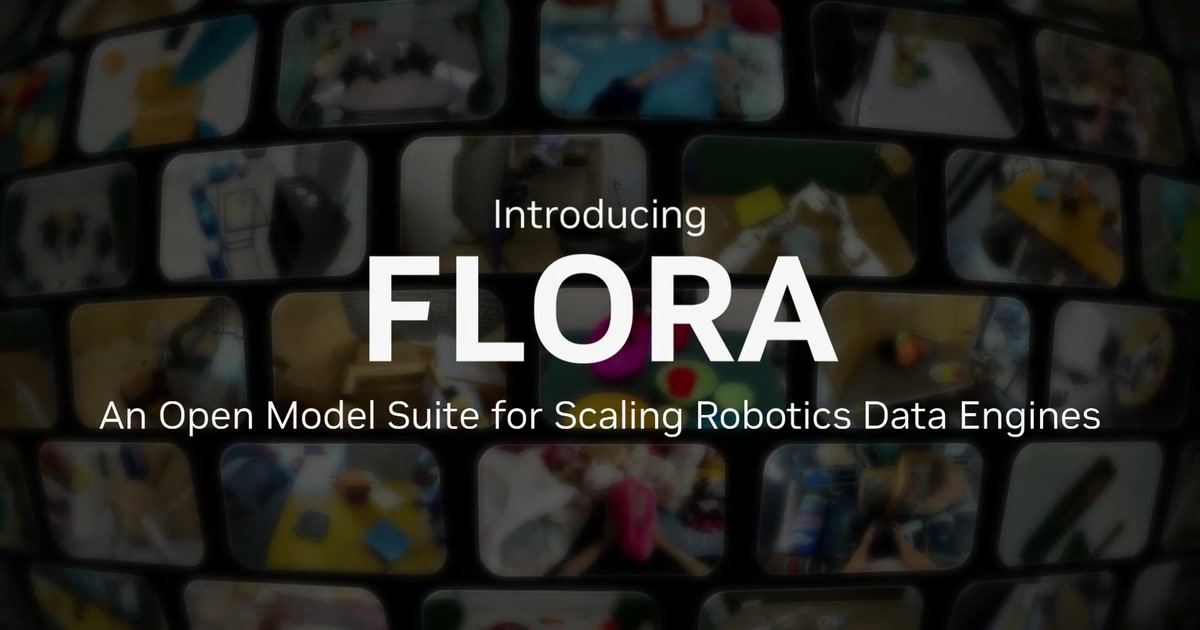
Nvidia has released Flora, an open set of models that labels robot training video, and says it is roughly 125 times cheaper than using GPT-6 Astra for the same job. Nvidia's Flora project page says the models are already used to train its GR00T robot models. The weights are on Hugging Face.
Robot teams collect hours of video of arms and hands doing tasks. Before that video can train anything, someone has to say what happens in it, which steps went well and whether the task worked. Doing that with a large API model gets expensive fast. Flora is Nvidia's bet that a purpose-built open model can do it at a fraction of the cost.
What Flora produces
Flora is a suite of three models, according to the Hugging Face collection: Flora-Captioner (27B parameters), Flora-TempSeg and Flora-Rewarder (28B). Together they produce three kinds of labels, which Nvidia ties to different stages of building a robot model:
- Outcome reward labels, to judge whether a real-world task succeeded.
- Process reward labels, which score individual steps and are used in reinforcement learning after pretraining.
- Timestamped captions, used to filter and balance the data a model is pretrained on.
Nvidia says the system labels 200,000 hours of data a day on 512 GB300 GPUs, and works on both human and robot recordings.
Mixed results against frontier models
The headline claim is cost. The accuracy picture, from Nvidia's own benchmark table, is more mixed.
- On DenseCaptionBench with human recordings, Flora beats GPT-6 Astra on segmentation (54.6 vs 44.2 F1) and caption quality (66.5 vs 60.3).
- On the robot-video half of that benchmark, GPT-5.6 Sol leads on all three measures shown.
- On RoboReward, Flora has the lowest error (40.0, against 55.4 for the next best).
- On DenseRewardBench, Flora's recall of failed steps is 53.3, while the other models score 1.0 or lower.
- On RubricBench, GPT-6 Astra is well ahead (3.6 vs 6.5, lower is better).
Nvidia describes Flora as competitive with GPT-6 Astra and ahead of other frontier models on its internal benchmarks. These are Nvidia's numbers on benchmarks it chose to report, and no independent test has been published.
What we don't know yet
The project page does not state a license, a release date or a link to code. The paper is linked from the page. Anyone planning to build on the weights should check the license on each Hugging Face model card first.
The failure-detection result is the one to watch. Robot teams struggle to find bad steps in large piles of video, and a labeler that catches over half of them, if it holds up outside Nvidia's tests, would be useful beyond Nvidia's own models.
Sources
- Flora: An Open Model Suite for Scaling Robotics Data EnginesNVIDIA Research
- Flora model collectionHugging Face