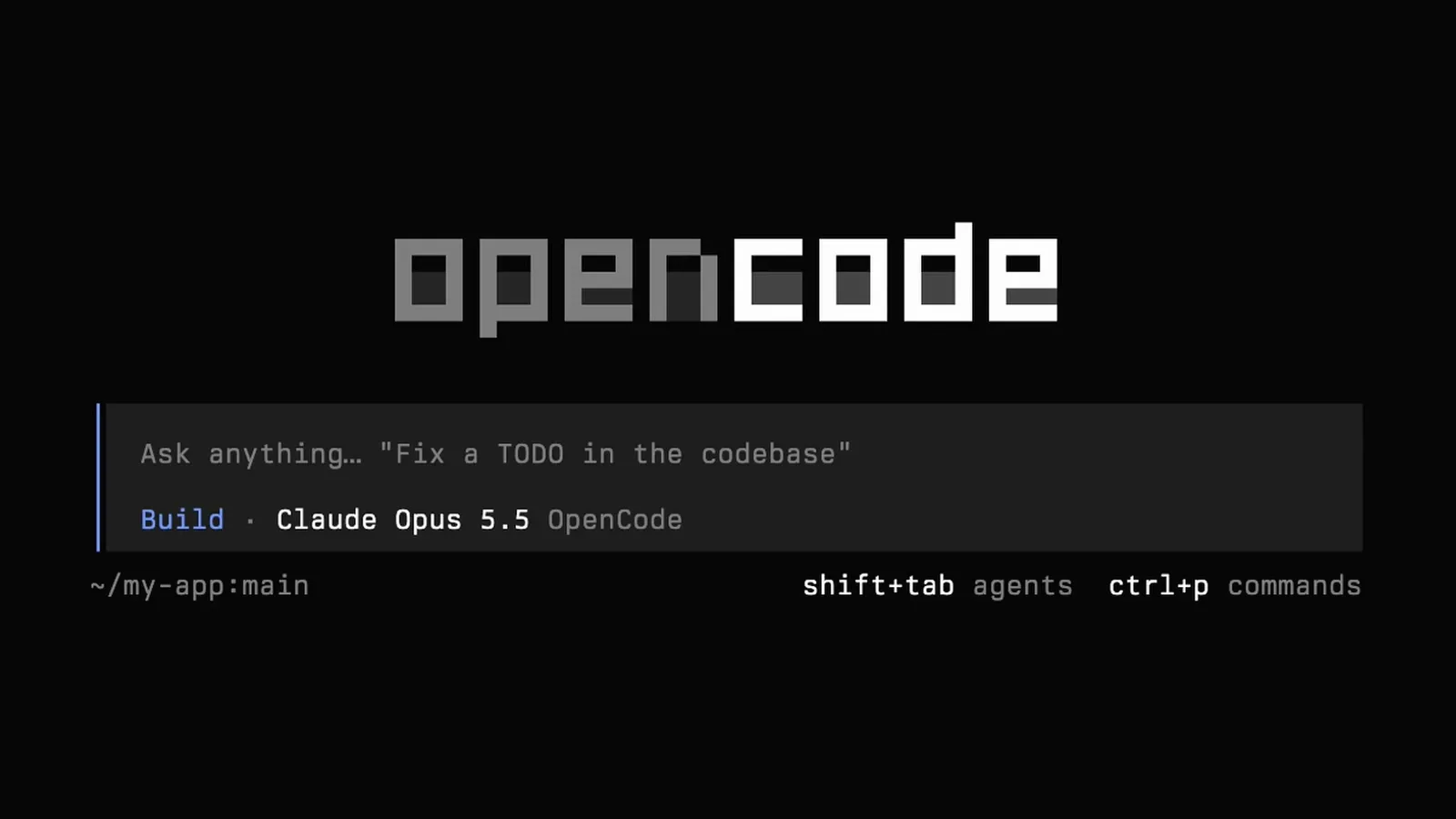
Key takeaways
- OpenCode is a free, MIT-licensed coding agent, and you can use its free models without an account.
- OpenCode Go costs $10 a month, Go Plus $40 and Go Teams $20 per member, as of November 17, 2026.
- OpenCode Zen now lives on as pay-per-token models in OpenCode Console, with a fee of 4.6% plus $0.31 on each credit purchase.
Yes, OpenCode is free. The coding agent is open source under the MIT license, costs nothing to install, and comes with a rotating set of free models. What costs money is the model behind it: your own provider's API, pay-per-token models in OpenCode Console (the service once sold as OpenCode Zen), or an OpenCode Go subscription from $10 a month, as of November 17, 2026.
That split is the business model. Anomaly, the company behind OpenCode, gives the agent away and charges for model access, and it sells that access to people who use rival agents too.
What is free in OpenCode
The agent itself. The GitHub repository carries the MIT license, which allows commercial use, changes and redistribution. Anomaly's press page says OpenCode has over 220,000 GitHub stars and over 22 million developers a month. It runs in the terminal, as a desktop and mobile app, and as an SDK.
Three ways to run it cost nothing extra:
- Free models. The home page says you can use them with no account.
- Local models. The providers docs say OpenCode finds models served by Ollama, LM Studio and vLLM on your machine.
- Plans you already pay for. You can sign in with ChatGPT Plus or Pro, or GitHub Copilot. ChatGPT usage "counts against your plan, so these models show no cost," the docs say.
With your own API key from Anthropic, OpenAI, Google or any of the 200+ providers OpenCode supports, you pay that provider its normal rates and OpenCode adds nothing. Our Claude Code vs OpenCode and Codex vs OpenCode comparisons weigh this against paid agents.
What OpenCode costs: every option
| Option | Price (as of November 17, 2026) | What you get |
|---|---|---|
| OpenCode app | $0 | MIT-licensed agent |
| Free models | $0 | 15 models, each free for a limited time |
| Your own key or plan | Your provider's prices | 200+ providers, ChatGPT and Copilot sign-in |
| OpenCode Console (formerly Zen) | Per token, plus 4.6% + $0.31 per credit purchase | 29 paid models |
| OpenCode Go | $10 a month | 32 coding models with monthly limits |
| OpenCode Go Plus | $40 a month | Same models, higher limits |
| OpenCode Go Teams | $20 per member a month | Limits $5 higher than Go on every model |
OpenCode Zen is now OpenCode Console
The Zen name is gone. The old address, opencode.ai/zen, redirects to the Console models page, and the docs describe the same service: models "tested and verified by the OpenCode team," sold per token.
You sign in, add credits and get an API key that works in OpenCode or another agent. Each credit purchase carries a fee of 4.6% plus $0.31. Owners can set monthly budgets per workspace and per member. Some list prices per million tokens, as of November 17, 2026:
| Model | Input | Output |
|---|---|---|
| Claude Opus 5.5 | $4.00 | $20.00 |
| Claude Sonnet 5.5 | $2.00 | $10.00 |
| GPT-5.5 | $5.00 | $30.00 |
| Gemini 4 Argon | $2.00 | $10.00 |
| Kimi K3 | $3.00 | $15.00 |
| DeepSeek V4.1 Flash | $0.30 | $1.20 |
How much OpenCode Go costs
OpenCode Go is the flat-rate option: $10 a month, $40 for Go Plus, or $20 per member for Go Teams, as of November 17, 2026. It covers 32 models, including Kimi K3, GLM-5.3, DeepSeek V4 Pro, Gemini 4 Argon, Grok 4.7 and Claude Haiku 5.5.
Each model has its own monthly limit, written as dollars of usage. A rolling 5-hour window allows 20% of it and a weekly window 50%.
| Model | Go: requests per 5 hours | Go Plus: requests per 5 hours | Monthly limit (Go / Go Plus) |
|---|---|---|---|
| Kimi K3 | 98 | 392 | $15 / $60 |
| GLM-5.3 | 198 | 1,580 | $15 / $120 |
| Gemini 4 Argon | 566 | 2,260 | $30 / $120 |
| Claude Haiku 5.5 | 3,850 | 15,400 | $15 / $60 |
| DeepSeek V4.1 Flash 1017 | 43,300 | 86,700 | $100 / $200 |
Request counts are Anomaly's estimates. At a limit you can switch to free models or turn on Extra Usage, which bills your Console credit. Go also works in Claude Code, Codex, Hermes and Pi. You can cancel any time, and Anomaly may refund a charge within 14 days if you've used almost none of it.
Is OpenCode Go worth it
For $10, every model in Go gets at least $15 of usage a month. On cheap models that goes far: DeepSeek V4.1 Flash 1017 gets $100. On the strongest it doesn't: about 98 Kimi K3 requests per 5 hours.
Go makes sense if you code most days with open-weight models and want a fixed bill. If you mostly want Claude Opus or GPT-5.5, which Go doesn't include, pay per token or use a ChatGPT plan. Our OpenCode v2 article covers how Go fits Anomaly's plans.
Which OpenCode models are free right now
The Console docs list 15 free models as of November 17, 2026: Big Pickle, Iceman Free, Inkling 2 Small Free, GLM-5.3-Flash Free, DeepSeek V4.1 Flash Free, MiniMax M3.1 Flash Free, MiMo-V2.6-Flash Free, Beam Free, Flint 40B Free, LongCat 2.5 Free, Hy4 flash Free, Jev 1.13 Free and three NVIDIA Nemotron models.
The newest is Hy4 flash Free, labeled "New" on the Go page. All are offered for a limited time, with no end date. Free models have a daily request limit; the docs give a number only for LongCat 2.5 Free, 100 a day. They work only inside OpenCode.
What free models do with your code
Free costs you data on some of them. GLM-5.3-Flash Free, DeepSeek V4.1 Flash Free, MiniMax M3.1 Flash Free and Hy4 flash Free keep nothing and don't train on it.
The docs say data sent to Big Pickle, Iceman Free, MiMo-V2.6-Flash Free and Flint 40B Free may be used to improve the model. Inkling 2 Small Free keeps data for training. The Nemotron models are NVIDIA trials that log usage, and the docs say not to send them confidential data. LongCat 2.5 Free is hosted in China. Set OPENCODE_DISABLE_FREE_MODELS=1 to hide all free models.
Is OpenCode safe
The code is public, so anyone can check what the agent does. The terminal app shows each edit as a diff and lets you choose which commands run without asking. Your code goes to whichever model provider you pick, under its terms. On Go, endpoints that train on your requests are blocked by default.
OpenCode Browse is free and open source
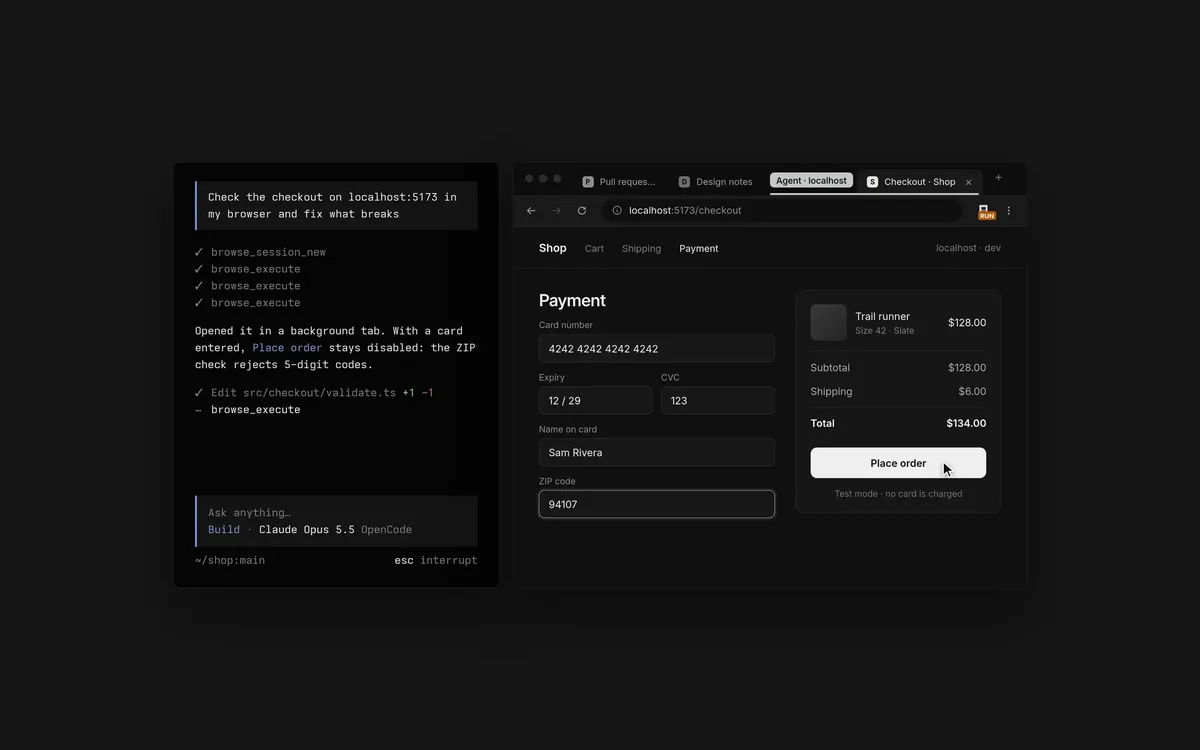
Anomaly's newest product, OpenCode Browse, reached the Hacker News front page on November 16. It is an MCP server and a Chromium extension that let an agent use your real browser, with your logins. MCP, the Model Context Protocol, is a standard way to plug tools into AI agents. The agent works in background tabs and hands the tab back to you for a login, 2FA or a payment.
Browse has no price on its page. Its source is on GitHub under the MIT license, and it works with OpenCode, Claude Code, Cursor, Codex and Zed. The repository says nothing leaves your computer except what your agent sends to its model provider, so the only bill is the model you already use.
Frequently asked questions
Is OpenCode open source?
Yes. The code is on GitHub at anomalyco/opencode under the MIT license, which allows commercial use, changes and redistribution.
What happened to OpenCode Zen?
The Zen name is gone. opencode.ai/zen now redirects to the models page of OpenCode Console, which sells the same tested models per token from prepaid credit.
Is OpenCode Go worth it?
For $10 a month, Go gives each of its 32 models a monthly allowance of at least $15 of usage. It suits people who code daily with open-weight models; it doesn't include Claude Opus or GPT-5.5.
What is the new free model in OpenCode?
As of November 17, 2026, the newest free model is Hy4 flash Free, labeled New on the Go page. All 15 free models are offered for a limited time.
Sources
- OpenCode Go docsAnomaly
- OpenCode GoAnomaly
- OpenCode Console models docsAnomaly
- OpenCode Console models and pricesAnomaly
- OpenCode providers docsAnomaly
- OpenCodeAnomaly
- OpenCode press pageAnomaly
- anomalyco/opencodeGitHub
- OpenCode BrowseAnomaly
- anomalyco/browseGitHub