Key takeaways
- Sam Altman wrote on June 10, 2025 that an average ChatGPT query uses about 0.34 watt-hours and 0.000085 gallons (about 0.32 mL) of water.
- Google put a median Gemini app text prompt at 0.24 Wh, 0.03 g CO2e and 0.26 mL of water in May 2025; none of the companies' per-prompt figures includes training.
- The IEA expects data center electricity use to grow from about 415 TWh in 2024 to about 945 TWh in 2030.
One ChatGPT prompt has a small environmental cost, by the companies' own numbers. OpenAI CEO Sam Altman wrote on June 10, 2025 that an average ChatGPT query uses about 0.34 watt-hours of electricity and about 0.32 milliliters of water. So is ChatGPT bad for the environment? Per prompt, barely. The real cost sits in the data centers being built to serve billions of prompts a day, and that cost is growing fast.
The per-prompt figures come from the companies themselves, nobody has audited them, and they leave out training, image and video generation, and long answers from reasoning models.
How much energy and water one ChatGPT prompt uses
Altman gave the figure in a blog post, The Gentle Singularity, on June 10, 2025. He said the average query uses "about 0.34 watt-hours, about what an oven would use in a little over one second." He put water at 0.000085 gallons, "roughly one fifteenth of a teaspoon." That is about 0.32 milliliters.
He did not say how OpenAI measured it, which model it refers to, or whether it includes cooling and idle servers.
Google published a fuller account. In an August 21, 2025 post, it said the median text prompt in the Gemini app, measured in May 2025, used:
- 0.24 watt-hours of energy, which Google compares to watching TV for less than nine seconds
- 0.03 grams of CO2 equivalent
- 0.26 milliliters of water, about five drops
Google counted the chips, host processors and memory, idle backup machines, and data center overhead such as cooling. Counting only the active AI chips would give 0.10 watt-hours, a figure Google itself calls "an optimistic scenario at best." Google also said the energy per median prompt fell 33 times, and the carbon 44 times, between May 2024 and May 2025. Its footnotes say an independent third party has not verified the figures.
Mistral went furthest. On July 22, 2025 it published a lifecycle analysis of its Mistral Large 2 model, done with the consultancy Carbone 4 and the French ecological transition agency ADEME, and peer reviewed by Resilio and Hubblo. One 400-token answer in its Le Chat assistant came to 1.14 grams of CO2 equivalent and 45 milliliters of water.
| Company (date published) | What was measured | Energy | Emissions | Water |
|---|---|---|---|---|
| OpenAI (June 10, 2025) | Average ChatGPT query | 0.34 Wh | Not given | 0.32 mL |
| Google (August 21, 2025) | Median Gemini app text prompt, May 2025 | 0.24 Wh | 0.03 g CO2e | 0.26 mL |
| Mistral (July 22, 2025) | One 400-token Le Chat answer, lifecycle | Not given | 1.14 g CO2e | 45 mL |
Mistral's water figure is about 170 times Google's. That gap says more about method than about the models. Mistral says it followed a full lifecycle standard (ISO 14040/44), while Google counted its data centers' own water use. The three numbers are not directly comparable, and each company chose what to count.
What ChatGPT adds up to across billions of prompts
Small numbers get large when multiplied. In a paper published September 15, 2025, OpenAI researchers said ChatGPT handled 18 billion messages a week by July 2025, from about 700 million weekly users on consumer plans.
If every message used Altman's 0.34 watt-hours, the arithmetic goes:
- 18 billion messages a week is about 2.57 billion a day.
- 2.57 billion times 0.34 Wh is about 870 megawatt-hours a day.
- Over a year, that is about 320 gigawatt-hours, or 0.32 terawatt-hours.
- Water: 2.57 billion times 0.32 mL is about 830,000 liters a day, or roughly 300,000 cubic meters a year.
That is rough. It assumes every message is an average query and leaves out business and API use, images and training. The International Energy Agency's Energy and AI report, published April 10, 2025, put all the world's data centers at about 415 terawatt-hours in 2024, around 1.5% of global electricity. On these numbers, ChatGPT's text chats would be under a tenth of a percent of that.
For one person, twenty prompts a day at 0.34 Wh comes to 6.8 watt-hours a day, or about 2.5 kilowatt-hours a year.
Why data centers are the bigger question
The per-prompt view misses where the growth is. The IEA projects data center electricity use will more than double to about 945 terawatt-hours by 2030, just under 3% of global demand, growing around 15% a year. It expects the United States to account for nearly half of the growth in its electricity demand through 2030.
For the US, a Lawrence Berkeley National Laboratory report released by the Department of Energy on December 20, 2024 found data centers used about 176 terawatt-hours in 2023, 4.4% of the country's electricity. It projected 325 to 580 terawatt-hours by 2028, or 6.7% to 12%.
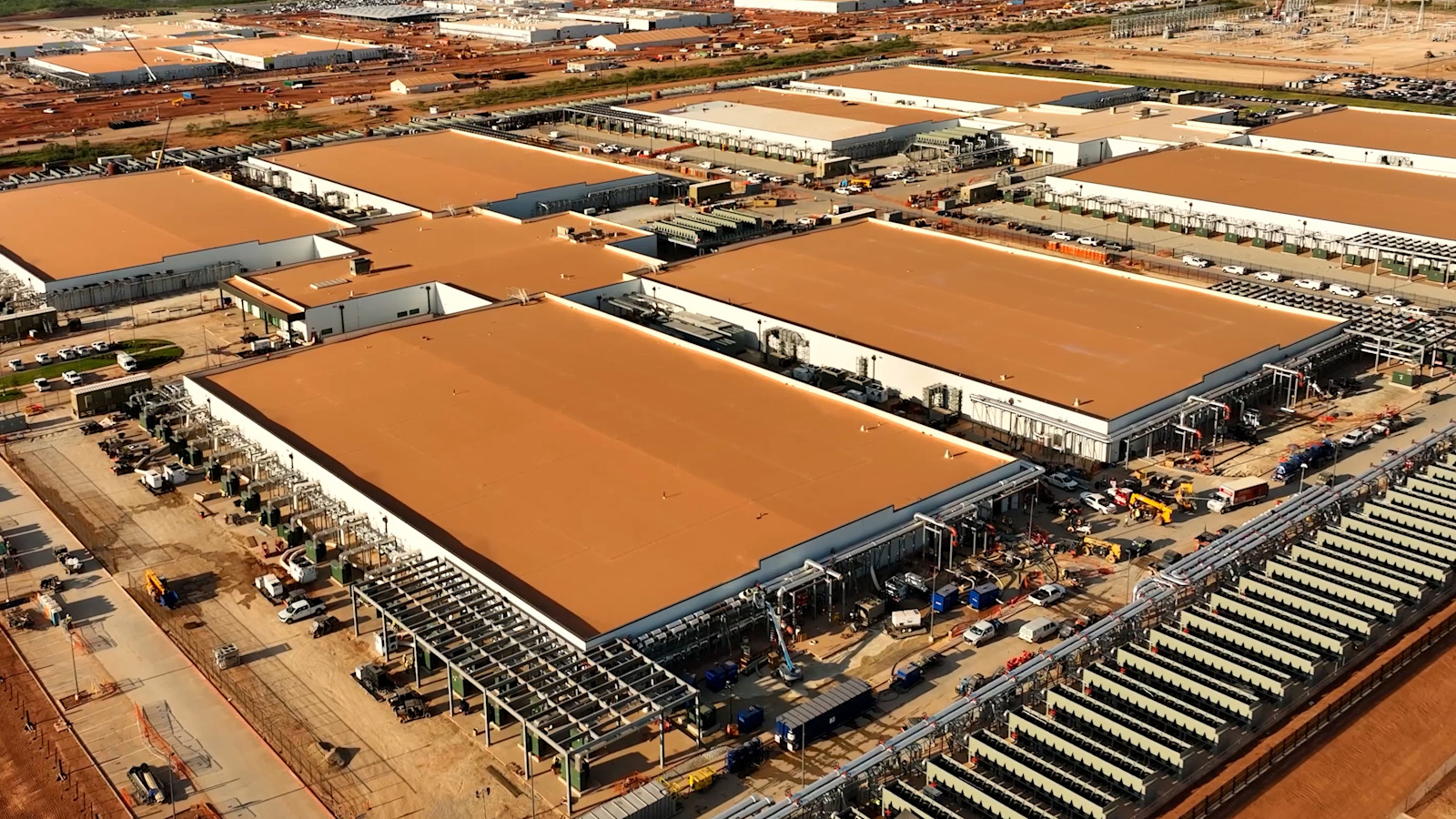
OpenAI is building at that scale. On September 23, 2025, it said its Stargate data center project, with partners including Oracle, had nearly 7 gigawatts of planned capacity and over $400 billion of investment over three years, with the flagship campus in Abilene, Texas already running. The post said nothing about water use or cooling. One proposed way around power and water limits on the ground, running AI chips in orbit, is covered in our explainer on Google's Suncatcher space data centers.
Microsoft's reports show what the build-out does to a company's footprint. Its 2025 sustainability report, released May 29, 2025, said total emissions were 23.4% above its 2020 baseline in fiscal 2024, while its energy use rose 168% over the same period. Its next report, on July 9, 2026, said fiscal 2025 emissions rose another 25% from the year before, mainly from data center expansion and a pause in buying unbundled renewable energy certificates. On water, Microsoft said that in fiscal 2025 it replenished more than it withdrew for the first time, through replenishment projects, but it did not give withdrawal or consumption totals in that post.
What the per-prompt numbers leave out
- Training. None of the per-prompt figures includes the energy to train a model. Mistral reported it separately: Mistral Large 2 accounted for 20.4 kilotons of CO2 equivalent and 281,000 cubic meters of water across training and its first 18 months of use, as of January 2025.
- Images, video and long answers. All three companies measured text. Generating an image or a video, or a reasoning model that writes thousands of hidden tokens before it answers, uses more compute per request. None of the three published a figure for those.
- Hardware. Building the chips and servers has its own footprint. Only Mistral's lifecycle study tries to count it.
- Checks. Google says its numbers were not independently verified, and OpenAI published no method at all. Mistral's is the only one that outside reviewers checked.
- Age. All of these figures date from 2025, and Google warns that energy per prompt shifts as models change.
The short answer
On what the companies have published, a single ChatGPT prompt costs about as much electricity as a second of oven use and a few drops of water. The concern that holds up is the total: AI is a main reason data center electricity demand is set to double by 2030, and Microsoft's emissions are rising with it. Better answers would need what the companies have not given: audited figures, a method from OpenAI, and numbers for images, video and reasoning models.
Frequently asked questions
How much water does ChatGPT use per query?
Sam Altman wrote on June 10, 2025 that an average ChatGPT query uses about 0.000085 gallons of water, roughly 0.32 milliliters or one fifteenth of a teaspoon. OpenAI has not published how it calculated that figure.
What is ChatGPT's environmental impact per query?
OpenAI gives about 0.34 watt-hours of electricity and 0.32 mL of water per average query, as of June 2025, and no emissions figure. For comparison, Google put a median Gemini app text prompt at 0.24 Wh, 0.03 g of CO2 equivalent and 0.26 mL of water in May 2025.
Why is ChatGPT's water usage considered bad?
Per prompt the companies report small amounts, but data centers use water for cooling and the industry is growing fast. The IEA expects data center electricity use to more than double by 2030, and the per-prompt figures leave out training, image and video generation, and hardware.
How much electricity does ChatGPT use in a year?
OpenAI has not published a yearly total. As a rough estimate, OpenAI's figure of 18 billion messages a week (July 2025) times 0.34 Wh per average query comes to about 0.32 terawatt-hours a year, excluding training, images and business use.
Sources
- The Gentle SingularitySam Altman
- Measuring the environmental impact of AI inferenceGoogle Cloud
- Our contribution to a global environmental standard for AIMistral AI
- How people are using ChatGPTOpenAI
- Five new Stargate sitesOpenAI
- Energy and AI: executive summaryInternational Energy Agency
- DOE releases new report evaluating increase in electricity demand from data centersU.S. Department of Energy
- Our 2025 Environmental Sustainability ReportMicrosoft
- Responsibly building the AI futureMicrosoft