Key takeaways
- A text watermark biases which words a model picks using a secret key, and a detector with the key can test for that bias statistically.
- Google DeepMind's SynthID-Text, published in Nature in October 2024, showed no significant quality difference across about 20 million Gemini responses.
- Since November 16, 2026, text from Claude Opus 4.6, Opus 4.5, Sonnet 4.5 and Haiku 4.5 carries Anthropic's watermark, which may be missing if sampling settings are changed.
An AI watermark is a hidden signal that an AI system puts into the text, images, audio or video it makes, so that a detector holding the right key can later tell the content came from that system. For text, the most common kind is a slight, secret bias in which words the model picks. Google DeepMind's SynthID is the best-known example, and on November 16, 2026 Anthropic's release notes said text from Claude Opus 4.6, Opus 4.5, Sonnet 4.5 and Haiku 4.5 now carries Anthropic's own text watermark, which the company says is a version of SynthID-Text.
Watermarks matter because AI text, images and audio are now hard to tell apart from human work, and the labs are rolling marks out across their models. Knowing how they work also shows what they can and cannot prove.
How a text watermark works
A language model writes one token at a time. A token is a word or a piece of a word. At each step the model scores every possible next token, then picks one at random, weighted by those scores. Often several tokens are almost equally good: "big", "large" and "huge" might all fit.
A watermark uses that freedom. Instead of an ordinary random draw, the model makes its pick with a pseudo-random process seeded by a secret key and the last few tokens. The reader sees normal text. Someone with the key can check whether the choices lean the way the key predicts, far more often than chance would allow.
The green-list method
The idea was laid out in A Watermark for Large Language Models by John Kirchenbauer and colleagues, first posted in January 2023 and presented at ICML 2023. Before each token, the previous token is hashed to seed a random number generator. That splits the vocabulary into a "green list" and a "red list". The model then adds a small bonus to the scores of green tokens, so it picks them more often without being forced to.
Detection needs no access to the model. A detector recounts how many tokens in a passage fall on their green list and computes a z-score, a measure of how far that count is from what unmarked text would give. The paper flags text when z is above 4, which corresponds to a false-positive rate of 3 in 100,000, and says the mark can be found in spans as short as 25 tokens.
SynthID-Text and tournament sampling
Google DeepMind's version was published in Nature on October 23, 2024 by Sumanth Dathathri and colleagues. It also changes only the sampling step, not the model's training. A hash of the last four tokens plus a secret key seeds the process. The model then draws a set of candidate tokens and runs them through a knockout "tournament", where pseudo-random scoring functions decide which candidate wins each round. The paper's experiments use 30 rounds.
Two numbers from the paper stand out:
- Quality. Google tested the watermark live in Gemini on about 20 million responses. Thumbs-up and thumbs-down rates differed by 0.01% and 0.02%, which the authors call statistically insignificant.
- Cost. On Gemma 7B, the 30-round tournament added 0.57% to the time per token.
Google released the code on GitHub, and Hugging Face added SynthID Text to its Transformers library in version 4.46.0, announced on the same day as the paper. Developers can watermark their own models with a private key and train a detector for it.
Watermarks for images, audio and video
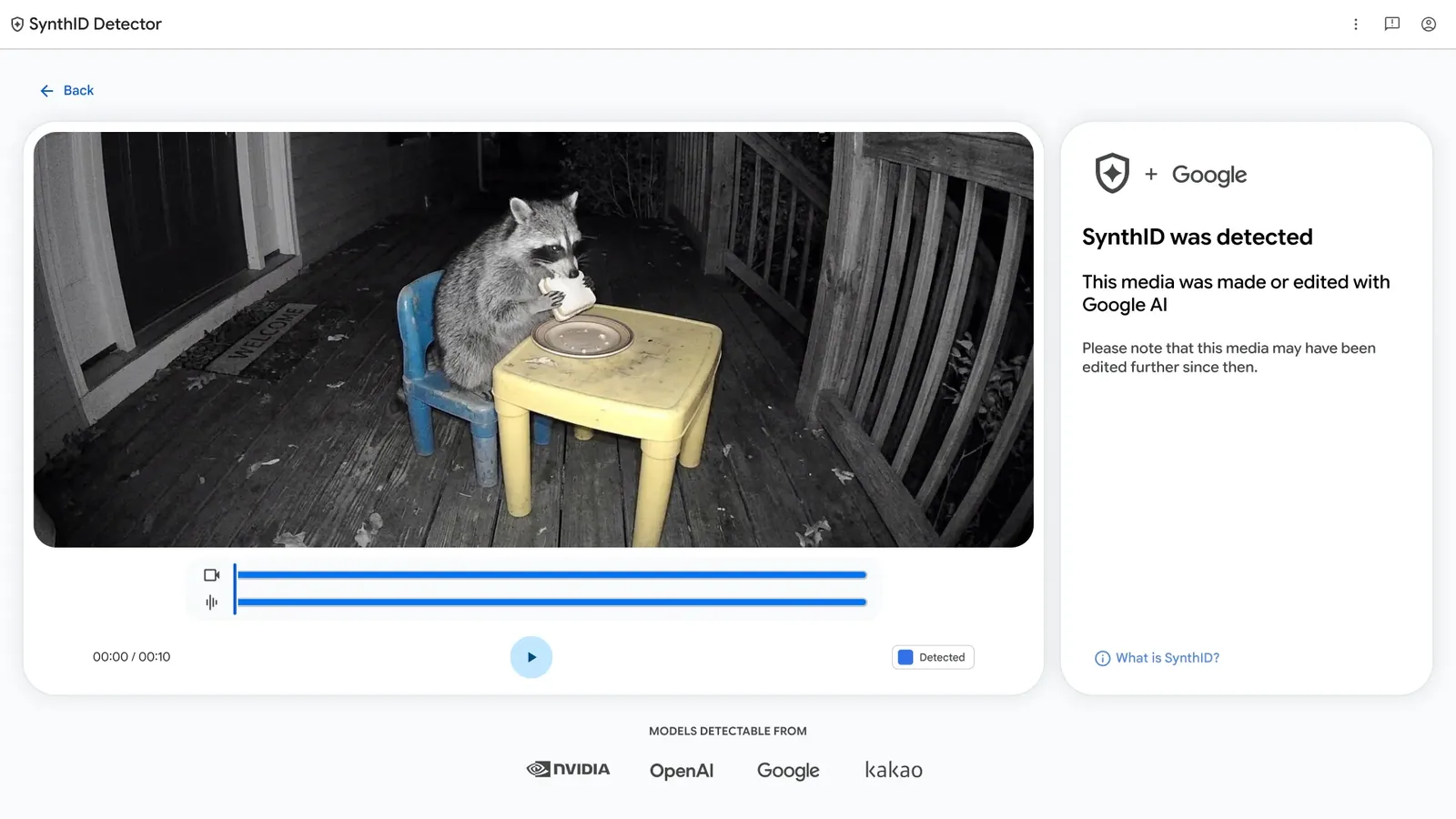
Pictures and sound have no word choices to bias, so the mark goes into the content itself. According to Google's SynthID page, images and video get an invisible watermark at creation that is designed to survive cropping, filters, frame-rate changes and lossy compression. Audio from Lyria and NotebookLM's podcast feature gets an inaudible mark designed to survive noise, MP3 compression and speed changes. Gemini, Search and Chrome can check an uploaded file for the mark, and the SynthID Detector portal is open to anyone. Google says it also detects content from partners, naming OpenAI, NVIDIA and Kakao.
Watermarks vs. C2PA content credentials
The other main approach is metadata. C2PA, a standards group whose steering committee includes Adobe, Google, Meta, Microsoft, OpenAI and Sony, defines Content Credentials: a record attached to a file that shows where it came from and how it was edited. Anthropic, for example, adds signed C2PA credentials to PNG and JPEG files Claude creates, according to its help center.
The two do different jobs. A credential is easy to read and can say a lot, but it lives next to the content, and Anthropic's own article lists stripped metadata as one reason a mark can go missing. A watermark lives inside the content and survives copy and paste, but it carries only a yes-or-no signal, and only the key holder can read it. That is why companies tend to use both.
Who uses what
| Company | Text | Images, audio, video | How to check |
|---|---|---|---|
| SynthID Text in the Gemini app and web | SynthID watermark | SynthID Detector, or ask Gemini, Search or Chrome | |
| Anthropic | Text watermark based on SynthID-Text | C2PA credentials on supported files | Detection API in private preview; free Claude Content Checker for credentials |
| Open-source developers | SynthID Text in Hugging Face Transformers, or green-list code | Varies | Their own detector and key |
On the Claude side, Anthropic says newer models carry the mark on its own apps and on cloud partners. The text watermark docs add a caveat for older models, including Opus 4.6, Sonnet 4.6, Opus 4.5, Sonnet 4.5 and Haiku 4.5: if a request sets temperature, top_p or top_k to a non-default value, the output might not carry the watermark. Our earlier report covers how that rollout reached older Claude models.
What watermarks can't do
Every source above names the same weak spots.
- Rewriting. The Nature paper says edits such as LLM paraphrasing weaken the mark. Anthropic's explainer says light editing probably won't remove it, but a complete rewrite will.
- Short text. Detection is a statistical test, and a few words give too little evidence. Anthropic says confidence grows with length.
- Low-entropy text. When only one word is correct, as in a fact, a quote or code, there is no choice to bias. The Hugging Face post on SynthID Text says the mark is less effective on factual answers, and Anthropic says it is sparser in code.
- False positives and what a hit means. Thresholds keep false alarms rare, but not at zero. Anthropic says a detected mark "is not fully conclusive": Claude may only have proofread or translated the text.
- Other models. A detector only finds its own key. A missing Claude mark says nothing about text from other systems, and the Nature authors note that watermarks are hard to enforce on open models anyone can run.
A watermark is useful evidence, not proof. Treat a positive result as "this probably passed through that model" and a negative one as "unknown", which is exactly how Google and Anthropic describe their own tools.
Frequently asked questions
What is SynthID?
SynthID is Google DeepMind's tool for watermarking and identifying AI-generated content. It marks text from the Gemini app and web, plus images, video and audio from Google's AI products, and its Detector portal lets anyone check a file.
Can an AI text watermark be removed?
Yes, with enough rewriting. Anthropic says light editing probably won't remove its mark but a complete rewrite will, and the SynthID-Text paper says paraphrasing by another model weakens detection.
Does a watermark prove a text was written by AI?
No. A detected mark is a strong signal that text passed through a given model, but the model may only have proofread or translated it, and a missing mark proves nothing.
What is the difference between a watermark and C2PA?
A watermark is hidden inside the content itself, while C2PA Content Credentials are signed metadata attached to a file. Metadata can carry more detail but can be stripped, so companies often use both.
Sources
- SynthIDGoogle DeepMind
- Scalable watermarking for identifying large language model outputs (Dathathri et al., Nature 2024)Nature
- A Watermark for Large Language Models (Kirchenbauer et al.)arXiv
- Claude Platform release notes, November 16, 2026Anthropic
- Text watermarkAnthropic
- How Claude's text watermark worksAnthropic
- How Claude marks AI-generated contentAnthropic
- Introducing SynthID TextHugging Face
- C2PA: Coalition for Content Provenance and AuthenticityC2PA