Key takeaways
- A vision language action model takes camera images and a text instruction and outputs robot actions, by adding an action output to a vision-language model.
- Google DeepMind's RT-2 named the idea in 2023 and doubled its predecessor's average success on unseen scenarios, 62% against 32%.
- Robot data is scarce: OpenVLA trained on 970,000 demonstrations and π0 on more than 10,000 hours, far less than the text behind language models.
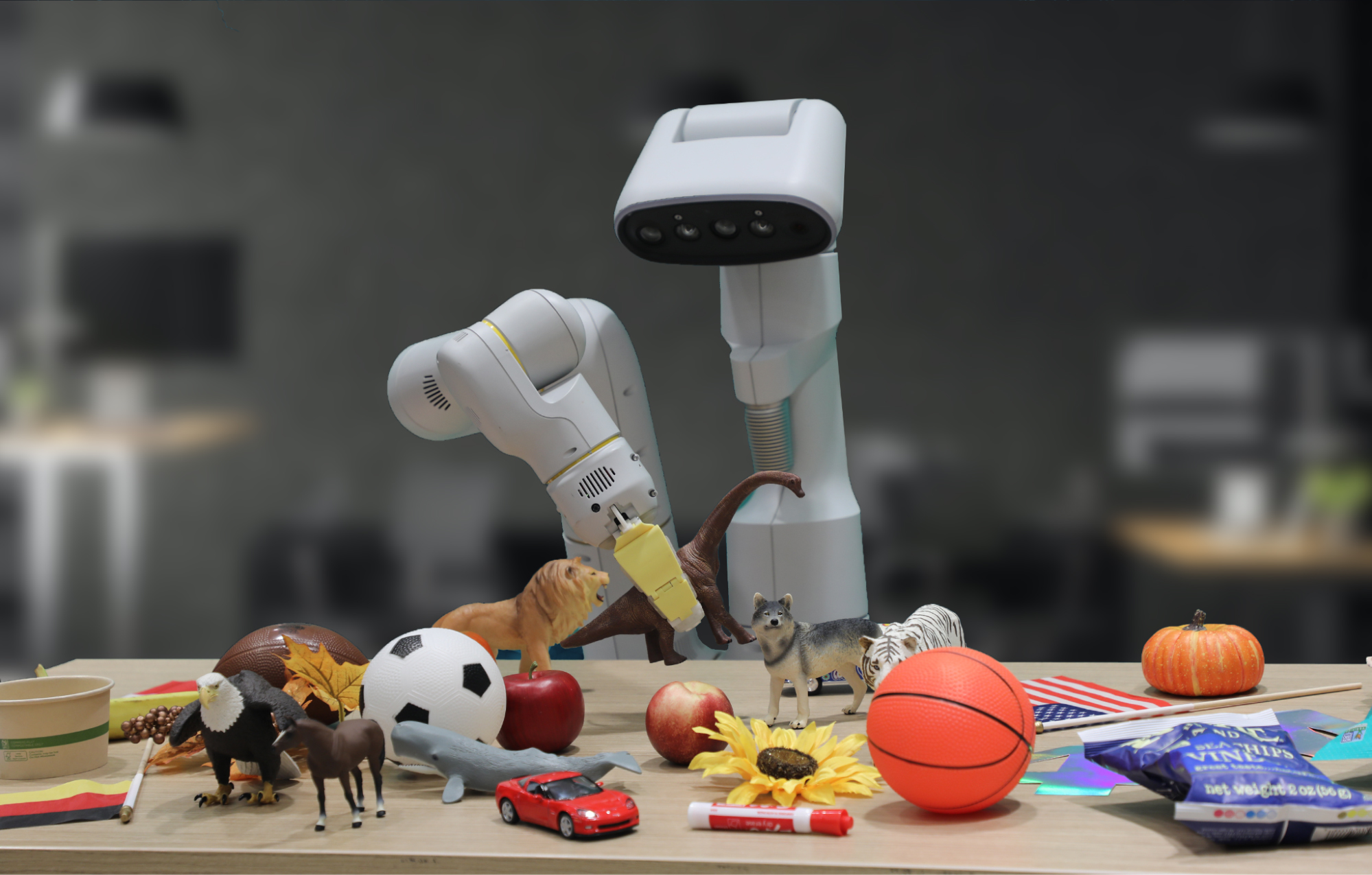
A vision language action model, or VLA, is an AI model that looks at camera images, reads an instruction such as "put the apple in the bowl", and outputs the movements a robot should make. It is a vision-language model that has been taught a third kind of output: instead of only answering in words, it answers in motor commands.
The idea matters because robot skills rarely carry over to new objects and rooms. VLAs try to fix that by borrowing what web-trained models already know about objects, words and scenes.
Where the term came from
Google DeepMind coined the name in July 2023 with RT-2. The team took vision-language models that had learned from internet images and text, PaLI-X at 5 billion and 55 billion parameters and PaLM-E at 12 billion, and trained them further on robot data alongside ordinary tasks like visual question answering.
The trick was to write actions as text. Each action became eight numbers: one to say whether the episode is over, six for how far and in which direction to move and rotate the gripper, and one for how wide to open it. Each continuous value was split into 256 steps, so every action fit into the model's normal vocabulary.
It worked. On tasks the robot had seen, RT-2 matched Google's earlier robot model, RT-1, at around 92%. On unseen objects, backgrounds and rooms, both RT-2 versions averaged 62% success against RT-1's 32%. RT-2 could also follow commands that never appeared in its robot data, such as picking the smallest object on the table.
How a VLA is built
Most VLAs follow one recipe:
- Start with a vision-language model.
- Add a way to output actions. There are two main approaches.
- Train on robot demonstrations, often mixed with ordinary image and text data so the model doesn't forget what it knew.
The first approach to actions is RT-2's: turn actions into tokens, the small units a language model reads and writes. The second adds a separate "action head" that produces smooth, continuous movements. Physical Intelligence's π0 does this with flow matching, a method that starts from random noise and refines it step by step into a movement, much like image generators do. π0 pairs a 3 billion parameter vision-language model, PaliGemma, with a 300 million parameter "action expert", for 3.3 billion parameters in total. It predicts 50 steps of motion at a time and can control robots at up to 50 times a second.
NVIDIA's GR00T N1 uses a similar split. A vision-language module NVIDIA calls "System 2" reads the scene and the instruction, and a diffusion transformer, "System 1", turns that into motor actions in real time. NVIDIA says the two are trained together end to end.
The data problem
Vision-language models learn from images and text gathered across the web. There is no web of robot movements, so demonstrations have to be recorded on real robots or generated in simulation.
The largest shared effort is Open X-Embodiment, a pooled dataset from 21 institutions covering 22 kinds of robots and 527 skills. OpenVLA, an open-source VLA, was trained on 970,000 real robot demonstrations drawn from it. π0 was pre-trained on more than 10,000 hours of robot data, including open datasets. NVIDIA says its GR00T models mix teleoperation data with human video and synthetic data from simulation.
Key examples
| Model | Who | Size | How it outputs actions |
|---|---|---|---|
| RT-2 (2023) | Google DeepMind | 5B, 12B and 55B | Actions written as text tokens |
| OpenVLA (2024) | Open-source research team | 7B | Actions as tokens |
| π0 (2024) | Physical Intelligence | 3.3B | Flow-matching action expert |
| GR00T 1.7 | NVIDIA | 3B, per its Hugging Face name | Chunks of continuous actions |
| Gemini Robotics 2.5 | Google DeepMind | Not published | Not published |
OpenVLA is the easiest place to start. It has 7 billion parameters, is built on Meta's Llama 2, and its authors report it beat the 55 billion parameter RT-2-X by 16.5 percentage points in task success across 29 tasks. The team released checkpoints and training code, and showed it can be fine-tuned on consumer GPUs.
Google DeepMind's current lineup is on its Gemini Robotics page. It lists Gemini Robotics 2.5, "our most advanced VLA model", for two-armed robots and full humanoids; Gemini Robotics On-Device 2, a smaller VLA that runs on the robot itself; and Gemini Robotics ER 2, a reasoning model that plans tasks. Only ER 2 is open to try, as a preview in Google AI Studio; the VLAs are limited to trusted testers. NVIDIA's Isaac GR00T page calls GR00T 1.7 its latest open VLA, with weights on GitHub and Hugging Face.
What VLAs still can't do
- New motions. The RT-2 authors say their model doesn't learn new physical skills. It reuses the movements in its robot data in new situations.
- Speed. The 55 billion parameter RT-2 ran at 1 to 3 actions per second, on cloud TPUs the robot called over the network. Smaller models and action chunks, predicting many steps at once, are the usual fix.
- Data and reliability. The π0 authors write that it is unclear which pre-training data helps most and how much is needed for near-perfect performance, and that not every task works reliably.
What this week's papers add
Two papers posted to arXiv this week test whether general-purpose models can skip part of the VLA recipe.
A Glimpse of Training VLMs as Foundation Models for Robotic Manipulation, posted on November 22 by a team mostly at Tsinghua University, trains a vision-language model called nanoAstra-9B, starting from Qwen3.5-9B, to write robot actions as plain text steps like "move x +5.0" and "gripper open", with no separate action head. It learned from about 5,300 hours of robot data. The authors report a 17.8% zero-shot success rate on the RoboTwin 2.0 benchmark, which they say beats the VLA baselines they tested, and call the work an "initial exploration". The cost: the model lost ground on general vision benchmarks, for example falling from 58.6% to 53.1% on MMMU.
Embo-Harness, posted on November 23 by researchers from Nanyang Technological University, SenseTime Research and others, goes further. It uses a frontier multimodal model, GPT-6-Astra, directly as the robot's policy, inside a loop of prompts, tools and short action sequences. On the RoboLab-120 benchmark it reports 83.3% success, against 28.0% for π0.5, 7.2% for GR00T N1.6 and 5.0% for π0 in the same table. The authors conclude that frontier models work best when they pick spatial targets, where the gripper should go, rather than low-level movements.
That result comes from one benchmark and one team, and the paper doesn't report how long each decision takes. It does suggest the line between a VLA and a general model driving a robot through tools is getting thinner.
Money is flowing into robot models too. Embo, a startup building them, raised a $110 million seed round on November 23. The other approach to watch is the world model, which predicts what happens next in a scene. Five of the baselines in the Embo-Harness table are world action models, robot policies built on that idea, and several of them scored above the VLAs.
Frequently asked questions
What does VLA stand for in AI?
VLA stands for vision-language-action. A VLA model takes images (vision) and an instruction (language) and outputs robot movements (action).
What is the difference between a VLA model and a world model?
A VLA maps what a robot sees and is told directly to its next actions. A world model predicts what will happen next in a scene, and world action models are robot policies built on that prediction.
Are there open source VLA models?
Yes. OpenVLA, a 7 billion parameter model, was released with checkpoints and training code, and NVIDIA publishes GR00T 1.7 weights on GitHub and Hugging Face.
What is the architecture of a VLA model?
Most start from a pretrained vision-language model. They then either write actions as tokens in its vocabulary, as RT-2 and OpenVLA do, or add a separate action module, such as π0's flow-matching action expert or GR00T N1's diffusion transformer.
Sources
- RT-2: Vision-Language-Action Models Transfer Web Knowledge to Robotic ControlarXiv (Brohan et al.)
- OpenVLA: An Open-Source Vision-Language-Action ModelarXiv (Kim et al.)
- π0: A Vision-Language-Action Flow Model for General Robot ControlarXiv (Black et al.)
- GR00T N1: An Open Foundation Model for Generalist Humanoid RobotsarXiv (NVIDIA)
- Open X-Embodiment: Robotic Learning Datasets and RT-X ModelsarXiv
- Gemini RoboticsGoogle DeepMind
- NVIDIA Isaac GR00TNVIDIA
- A Glimpse of Training VLMs as Foundation Models for Robotic ManipulationarXiv (Guo et al.)
- Embo-Harness: Towards Understanding Frontier-Model-as-Policy HarnessarXiv (Wu et al.)