Key takeaways
- NIST published three post-quantum standards on August 13, 2024: ML-KEM for key agreement and ML-DSA and SLH-DSA for signatures, with HQC chosen in March 2025 as a backup KEM.
- NIST IR 8547 deprecates RSA and elliptic-curve algorithms after 2030 and disallows them after 2035, while the UK NCSC sets 2035 for full migration.
- The AI-math results reported so far target factoring and discrete logarithms, which post-quantum algorithms do not use, but lattice-based schemes are not proven secure.
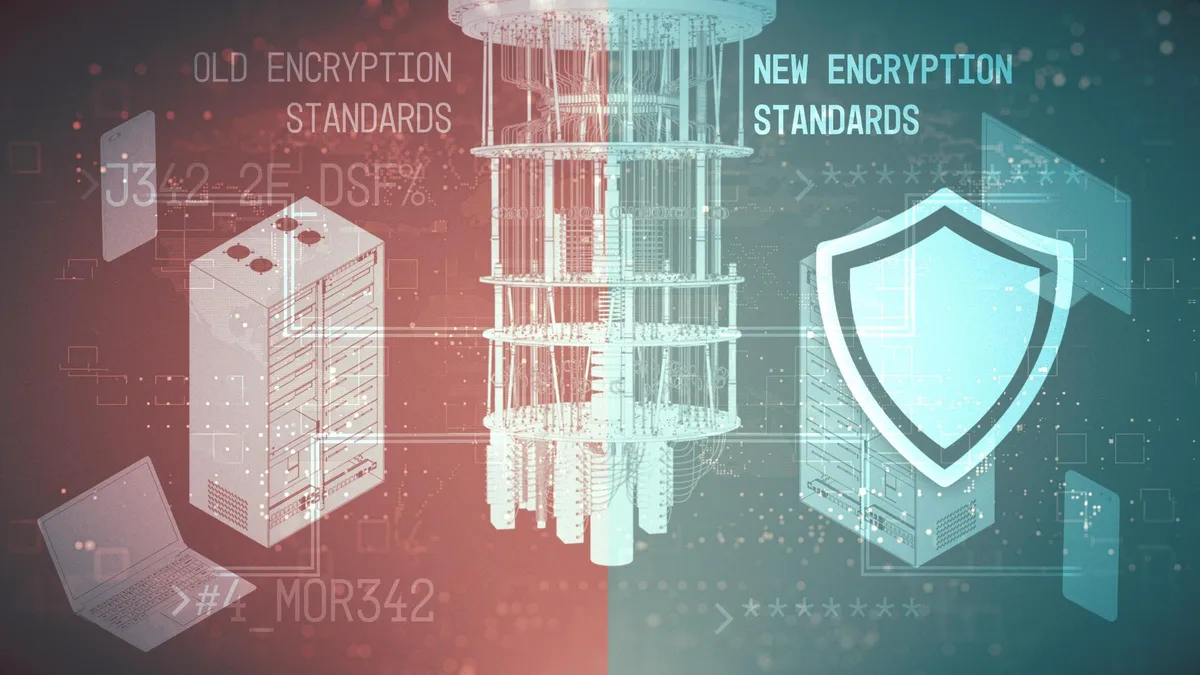
Post-quantum cryptography is public-key encryption and signing built on math problems that neither ordinary computers nor future quantum computers are known to solve quickly. NIST published the first three standards, FIPS 203, 204 and 205, on August 13, 2024. Chrome, Cloudflare, iMessage and Signal already use it, and US federal rules now set 2030 to 2035 as the window for retiring RSA and elliptic-curve cryptography.
The topic is back in the news. On November 28, 2026, The Guardian ran a story headlined "AI labs sitting on 'bombshell' revelations that could cause global chaos, experts warn," after the computer scientist Scott Aaronson wrote that AI labs may have found new results on the math behind today's encryption. The short version: post-quantum cryptography was built to replace exactly the algorithms at issue, but it is not a guarantee against every new idea in mathematics.
What post-quantum cryptography replaces
Secure connections use symmetric ciphers such as AES to scramble the data, and public-key algorithms to agree on the AES key and prove identity. The public-key half is the weak spot. RSA rests on how hard it is to factor large numbers. Elliptic-curve Diffie-Hellman and ECDSA rest on the discrete logarithm problem. A large enough quantum computer running Shor's algorithm would solve both. NIST's transition report, IR 8547, says the key-agreement schemes in its current standards "are vulnerable to Shor's Algorithm on a cryptanalytically relevant quantum computer."
No such machine exists yet. The urgency comes from what NIST calls "harvest now, decrypt later": an attacker records encrypted traffic today and decrypts it years from now. Data that has to stay secret for a decade is already exposed if it travels under RSA or elliptic-curve key exchange.
Symmetric cryptography mostly survives. IR 8547 says NIST's symmetric standards, AES included, are "significantly less vulnerable to known quantum attacks" and need no replacement beyond retiring 112-bit options in 2030.
The NIST post-quantum cryptography standards
NIST picked the algorithms through a public competition and published them as Federal Information Processing Standards (FIPS):
| Standard | Algorithm | Was called | Job | Based on |
|---|---|---|---|---|
| FIPS 203 | ML-KEM | CRYSTALS-Kyber | Key agreement (encryption) | Module lattices |
| FIPS 204 | ML-DSA | CRYSTALS-Dilithium | Digital signatures | Module lattices |
| FIPS 205 | SLH-DSA | SPHINCS+ | Digital signatures (backup) | Hash functions |
| In development | FN-DSA | FALCON | Digital signatures | NTRU lattices |
| In development | HQC-KEM | HQC | Key agreement (backup) | Error-correcting codes |
ML-KEM is the main event. A key-encapsulation mechanism, or KEM, sends a fresh shared secret that only the private-key holder can open. FIPS 203 defines three sizes, ML-KEM-512, 768 and 1024, and says its security "is related to the computational difficulty of the Module Learning with Errors problem," a lattice problem: roughly, recovering a hidden vector from many equations that each carry a small random error.
ML-DSA does the same job for signatures. SLH-DSA is the fallback: NIST calls it a backup in case ML-DSA proves vulnerable, and it relies on hash functions instead of lattices.
The same logic explains HQC. NIST selected it on March 11, 2025 as a backup to ML-KEM because it uses different math. "It's essential to have a fallback in case ML-KEM proves to be vulnerable," said NIST mathematician Dustin Moody. NIST expected a final HQC standard in 2027 and told organizations to keep migrating to ML-KEM in the meantime.
Migration deadlines from NIST, the US government and the NCSC
The dates are now firm on both sides of the Atlantic.
- NIST (US): IR 8547, finalized in October 2026, says RSA, ECDSA, EdDSA and elliptic-curve key agreement will be "deprecated after 2030" and "disallowed after 2035" under NIST standards. Deprecated means still allowed with accepted risk. Disallowed means not allowed.
- US federal agencies: under Executive Order 14412 and OMB memo M-26-15, as summarized in IR 8547, high-value and high-impact federal systems must use post-quantum key agreement by December 31, 2030 and post-quantum signatures by December 31, 2031. Agencies must also support TLS 1.3 by January 2, 2030. The 2035 goal from National Security Memorandum 10 covers the rest.
- NSA: its CNSA 2.0 suite for national security systems sets deadlines between 2030 and 2033 depending on the type of system, according to Cloudflare's summary of the regulators' timelines.
- UK: the National Cyber Security Centre's migration timeline, published March 20, 2025, asks organizations to finish discovery and an initial plan by 2028, do their highest-priority migrations by 2031, and "complete migration to PQC of all your systems, services and products" by 2035.
Where post-quantum cryptography already runs
Most of it is "hybrid": a classical and a post-quantum algorithm run together, so, as IR 8547 puts it, the key stays secure if at least one part holds.
- Chrome: Google turned on a hybrid of X25519 and Kyber for all desktop Chrome users, then switched to the standardized ML-KEM in Chrome 131, announced September 13, 2024.
- Cloudflare: in late October 2025 Cloudflare reported that over 50% of human traffic to its network was protected against store-now, decrypt-later attacks, mostly with the X25519MLKEM768 hybrid. It also said post-quantum certificates were unlikely to be broadly trusted by browsers before 2027.
- iMessage: Apple's PQ3 protocol, announced February 21, 2024 and shipped from iOS 17.4 and macOS 14.4, adds Kyber to the initial key setup and repeats a post-quantum rekey every 50 messages or so, and at least every 7 days.
- Signal: Signal added Kyber to its initial handshake with PQXDH in September 2023. On October 2, 2025 it began rolling out SPQR, a ratchet that uses ML-KEM 768 to keep adding quantum-safe secrets throughout a conversation.
The gap is authentication. The signatures that prove you reached the real server or phone are still mostly classical, because post-quantum certificate standards are not finished.
What it does and doesn't protect against in the AI-math scare
The current worry is not quantum computers. It is AI systems doing math. The computer scientist Scott Aaronson wrote on his blog on November 25 that he is "virtually certain, from multiple reliable sources, that the AI labs are now sitting on one or more bombshells" in cryptography, while warning that the details may have been garbled as they were passed along. Two days later he added that the result he has specific information about "will not lead to imminent danger" for deployed systems, and that he has no actionable information about rumored breaks that would. His posts do not say what the result is.
The public results so far point at the old problems. Google's Cogentic system posted an AI-written factoring algorithm on November 25 that is far slower in practice than existing methods, and a November 27 preprint claims a faster discrete-logarithm algorithm with no running times for real key sizes. Both target RSA and elliptic curves, the very things post-quantum cryptography removes. ML-KEM, ML-DSA and SLH-DSA do not rely on factoring or discrete logarithms, so an advance there does not touch them.
What post-quantum cryptography does not do is prove itself secure. Lattice problems are believed hard because decades of work, by people and now by machines, have not cracked them. A mathematical shortcut against lattices, found by anyone, would hurt ML-KEM and ML-DSA too. That is why NIST keeps a hash-based signature and a code-based KEM in reserve, and why hybrid deployments keep the classical algorithm in the loop.
The practical advice is unchanged: inventory where you use RSA and elliptic curves, and turn on hybrid ML-KEM where supported. The next marker is the final HQC standard, which NIST expects in 2027.
Frequently asked questions
What is post-quantum cryptography in simple terms?
It is public-key encryption and signing based on math problems, such as lattice and hash-based problems, that are not known to be solvable quickly by quantum or ordinary computers. It replaces RSA and elliptic-curve cryptography, which a large quantum computer could break.
What are the NIST post-quantum cryptography algorithms?
FIPS 203 (ML-KEM, from CRYSTALS-Kyber) for key agreement, FIPS 204 (ML-DSA, from CRYSTALS-Dilithium) and FIPS 205 (SLH-DSA, from SPHINCS+) for signatures. FN-DSA (from FALCON) and HQC are in development.
When do organizations have to switch to post-quantum cryptography?
NIST deprecates RSA and elliptic-curve algorithms after 2030 and disallows them after 2035. The most sensitive US federal systems must use post-quantum key agreement by December 31, 2030, and the UK NCSC asks for full migration by 2035.
Can AI break post-quantum cryptography?
No published AI result does. The AI-driven math announced so far targets factoring and discrete logarithms, which post-quantum algorithms do not rely on, though a future advance against lattice problems would affect ML-KEM and ML-DSA.
Sources
- NIST Releases First 3 Finalized Post-Quantum Encryption StandardsNIST
- FIPS 203, Module-Lattice-Based Key-Encapsulation Mechanism StandardNIST
- NIST IR 8547, Transition to Post-Quantum Cryptography StandardsNIST
- NIST Selects HQC as Fifth Algorithm for Post-Quantum EncryptionNIST
- Timelines for migration to post-quantum cryptographyNational Cyber Security Centre
- A new path for Kyber on the webGoogle
- State of the post-quantum Internet in 2025Cloudflare
- iMessage with PQ3: The new state of the art in quantum-secure messaging at scaleApple
- Quantum Resistance and the Signal ProtocolSignal
- Signal Protocol and Post-Quantum RatchetsSignal
- HOLY SHIT HOLY SHIT HOLY SHIT HOLY SHITShtetl-Optimized
- Every callShtetl-Optimized