Key takeaways
- Hyper-connections, proposed by ByteDance's Seed team in September 2024, copy the residual stream n times and learn how each layer reads from, writes to and mixes the copies.
- DeepSeek's mHC constrains the mixing to doubly stochastic matrices, cutting the worst-case signal gain in a 27B model from about 3,000 to about 1.6 at a 6.7% training-time cost, and DeepSeek-V4 uses it.
- The cmHC paper, posted November 20, 2026, nudges mHC's mixing toward an even blend in the first layers and reports loss gains of thousandths, with no downstream benchmarks.
Hyper-connections are a replacement for the residual connection, the shortcut that adds each layer's input back to its output in a transformer. Instead of one running signal, the model keeps several copies of it, four in most experiments, and learns how much each layer reads from and writes to each copy. ByteDance's Seed team proposed them in a September 2024 paper, and DeepSeek made them stable at scale with mHC, which its V4 models now use.
They are in the news again this week. A paper called cmHC, posted to arXiv on November 20, 2026, retunes DeepSeek's version. Google Research's November 23 post on its own residual redesign names hyper-connections as one of the main lines of work. For the plain shortcut they build on, see what a residual connection is.
The problem hyper-connections try to fix
A transformer rescales its numbers with a normalization step either before each block is added back to the residual stream (Pre-Norm) or after (Post-Norm). The ByteDance authors describe this as a seesaw. Pre-Norm keeps the training signal flowing to early layers, but the hidden states of deep layers end up very similar to each other, so extra layers add less. That is representation collapse. Post-Norm reduces collapse but brings back vanishing gradients, where early layers barely learn.
Their argument is that both versions fix the strength of the shortcut in advance. Hyper-connections let the network learn it.
How hyper-connections work
The token's vector is copied n times at the bottom of the model. The paper calls n the expansion rate. At each layer, three sets of learned weights do the work:
- One mixes the n copies into the single input the layer sees.
- One decides how much of the layer's output is added to each copy.
- One n-by-n matrix mixes the copies with each other.
At the top, the copies are summed. The weights start at values that make the model behave exactly like a standard Pre-Norm transformer, so training begins from the familiar design and moves away only if that helps.
There are two flavors. Static hyper-connections learn fixed weights. Dynamic ones add a small input-dependent correction, so the mixing can change from token to token.
One copy is not enough. On OLMo-1B, the dynamic version with n=1 had a validation loss of 2.819, worse than the baseline's 2.811. With n=4 it fell to 2.781. Going to n=8 added little.
What ByteDance measured
The headline result is on OLMoE-1B-7B, a mixture-of-experts model (one that runs only part of its network for each token) with 1.3 billion active parameters out of 7 billion, trained on 500 billion tokens. With hyper-connections at n=4, the authors report it converged 1.8 times faster. ARC-Challenge rose from 41.8 to 47.8 and BoolQ from 65.4 to 68.5.
On the dense OLMo-7B, the downstream average went from 70.1 to 71.0. The paper says the baseline's training loss spiked often and the hyper-connection model's did not.
The cost is not in compute. Extra parameters were about 0.03% of OLMo-1B and extra operations 0.2% per token. Memory is another story: measured use rose from 41.11 GB to 51.86 GB, or 26.1%, for OLMo-1B and 28.3% for OLMo-7B, because the model now carries n copies of every hidden state.
Why DeepSeek constrained them
DeepSeek-AI found the catch when it scaled up. The mixing matrices are unconstrained, so stacked across dozens of layers they stop acting like a shortcut and can amplify or shrink the signal. In a 27-billion-parameter model, the team measured the worst-case gain across layers at about 3,000, where a plain shortcut would give 1. Training loss surged around step 12,000.
The fix in mHC, short for manifold-constrained hyper-connections, is to force the copy-mixing matrix to be doubly stochastic: every entry non-negative, every row and every column summing to one. Such a matrix can only average the copies, never amplify them, and multiplying two of them gives another, so the property holds across the whole stack. DeepSeek gets there with the Sinkhorn-Knopp algorithm, which alternately normalizes rows and columns, run for 20 iterations. The worst-case gain dropped to about 1.6.
With fused kernels and activation recomputation, DeepSeek reports a training-time overhead of 6.7% at n=4. On its 27B model, mHC beat both a standard residual baseline and plain hyper-connections on seven of eight benchmarks:
| Benchmark | Baseline | Hyper-connections | mHC |
|---|---|---|---|
| BBH | 43.8 | 48.9 | 51.0 |
| DROP (F1) | 47.0 | 51.6 | 53.9 |
| GSM8K | 46.7 | 53.2 | 53.8 |
| MMLU | 59.0 | 63.0 | 63.4 |
| MATH | 22.0 | 26.4 | 26.0 |
The paper appeared at ICML 2026. The DeepSeek-V4 technical report lists mHC among the architecture changes in V4-Pro, a 1.6-trillion-parameter model with 49 billion active, and V4-Flash, with 284 billion and 13 billion active (our V4.1 Flash explainer covers the newer release). That puts hyper-connections in released models far larger than any the original paper tested.
What cmHC adds this week
The cmHC team, mostly from China Telecom's Xingchen AGI Lab with researchers from HKUST (Guangzhou), Harbin Institute of Technology (Shenzhen) and Huawei, argues mHC's constraint has a blind spot. The mixing matrices tend to stay close to the identity, so the copies barely talk to each other. Push too far the other way and the copies become indistinguishable.
Their fix pulls each matrix a few percent toward an even average of all copies (a contraction setting of 0.97 in the main runs), and does it only in the first two layers, so deeper layers stay close to a plain shortcut. It adds no learnable parameters.
The gains are small. On GPT-2-style models from 45 million to 360 million parameters, validation loss was 0.0024 to 0.0073 lower than mHC-lite, a lighter mHC variant. In a 300-billion-parameter mixture-of-experts run, training loss at step 22,000 was 0.0157 below mHC's. The paper reports loss only, with no downstream benchmarks, and the large runs are single runs. Fused operators for Huawei's Ascend 910C chips cut hyper-connection latency against mHC by 44.8% at the smallest hidden size tested and 24.1% at the largest. The code is out under Apache 2.0 and includes the HC, mHC and mHC-lite baselines.
How Google's approach differs
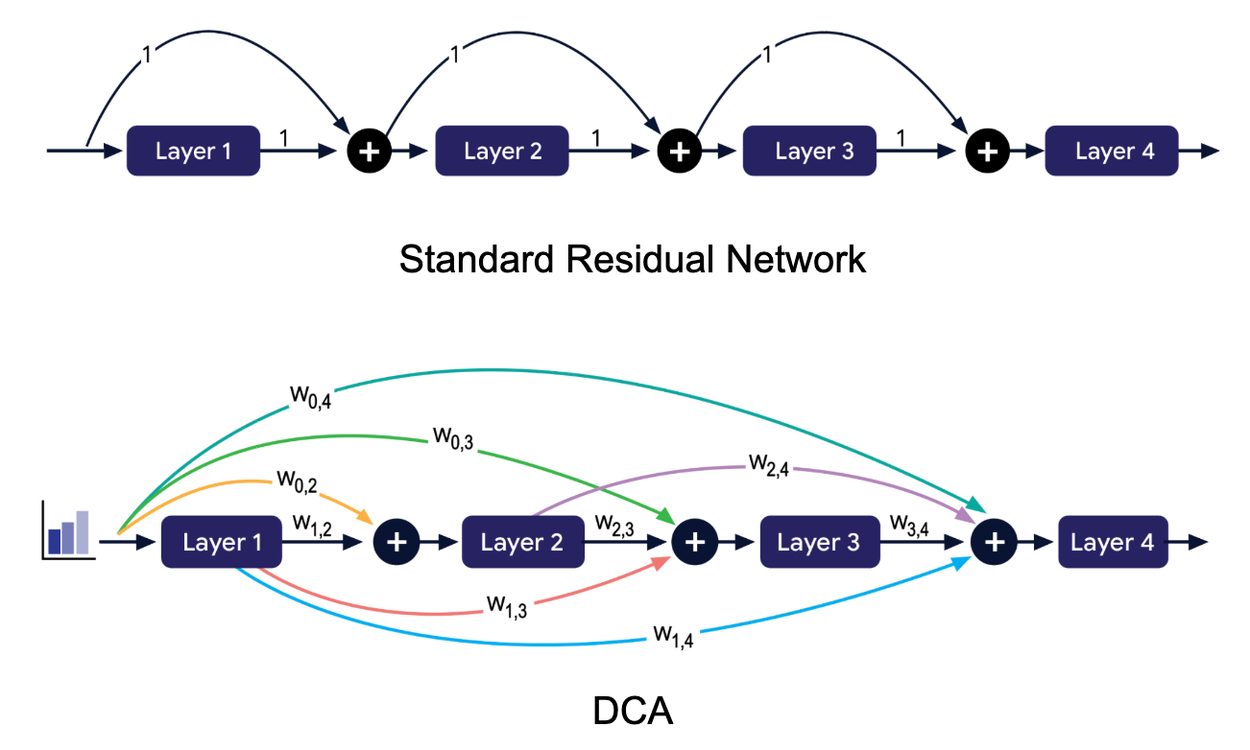
Google's DeepCrossAttention, from an ICML 2025 paper, keeps one stream but lets each layer read directly from all earlier layers' outputs, with input-dependent weights, like attention run across depth instead of across words. Google says it adds under 0.2% to model size, and that on the LM1B dataset a 30-layer model beat the perplexity a standard transformer needed 42 layers to reach.
What to make of it
Hyper-connections trade memory traffic for a residual stream the model can shape. ByteDance showed the gains on 1B to 7B models, DeepSeek showed they need guardrails and shipped them anyway, and cmHC's tweak is measured in thousandths of a loss point. The open question is no longer whether wider residual streams help. It is whether other labs, without DeepSeek's custom kernels, find the gains worth the extra memory traffic.
Frequently asked questions
What is the difference between hyper-connections and mHC?
Hyper-connections let the matrix that mixes the residual copies take any values. mHC, from DeepSeek, forces it to be doubly stochastic, with non-negative entries and rows and columns that sum to one, which DeepSeek found keeps training stable at 27B parameters.
Does DeepSeek use hyper-connections?
Yes, in constrained form. The DeepSeek-V4 technical report lists manifold-constrained hyper-connections (mHC) among the architecture changes in V4-Pro and V4-Flash.
Are hyper-connections the same as residual connections?
They generalize them. Hyper-connections start out behaving exactly like a standard Pre-Norm residual connection and then learn different mixing weights during training. With a single copy (n=1) they did not beat the baseline in ByteDance's tests.
Is there code for hyper-connections?
The cmHC repository on GitHub, released under Apache 2.0, includes implementations of hyper-connections, mHC and mHC-lite as baselines alongside cmHC itself.
Sources
- Hyper-ConnectionsarXiv (Zhu et al., ByteDance)
- mHC: Manifold-Constrained Hyper-ConnectionsarXiv (Xie et al., DeepSeek-AI)
- mHC: Manifold-Constrained Hyper-Connections (ICML 2026 proceedings)PMLR
- DeepSeek-V4: Towards Highly Efficient Million-Token Context IntelligencearXiv (DeepSeek-AI)
- cmHC: Balancing Stream Mixing in Hyper-Connections via Geometric ContractionarXiv (He et al., China Telecom)
- cmHC code repositoryGitHub
- Supercharging transformer residual connectionsGoogle Research
